
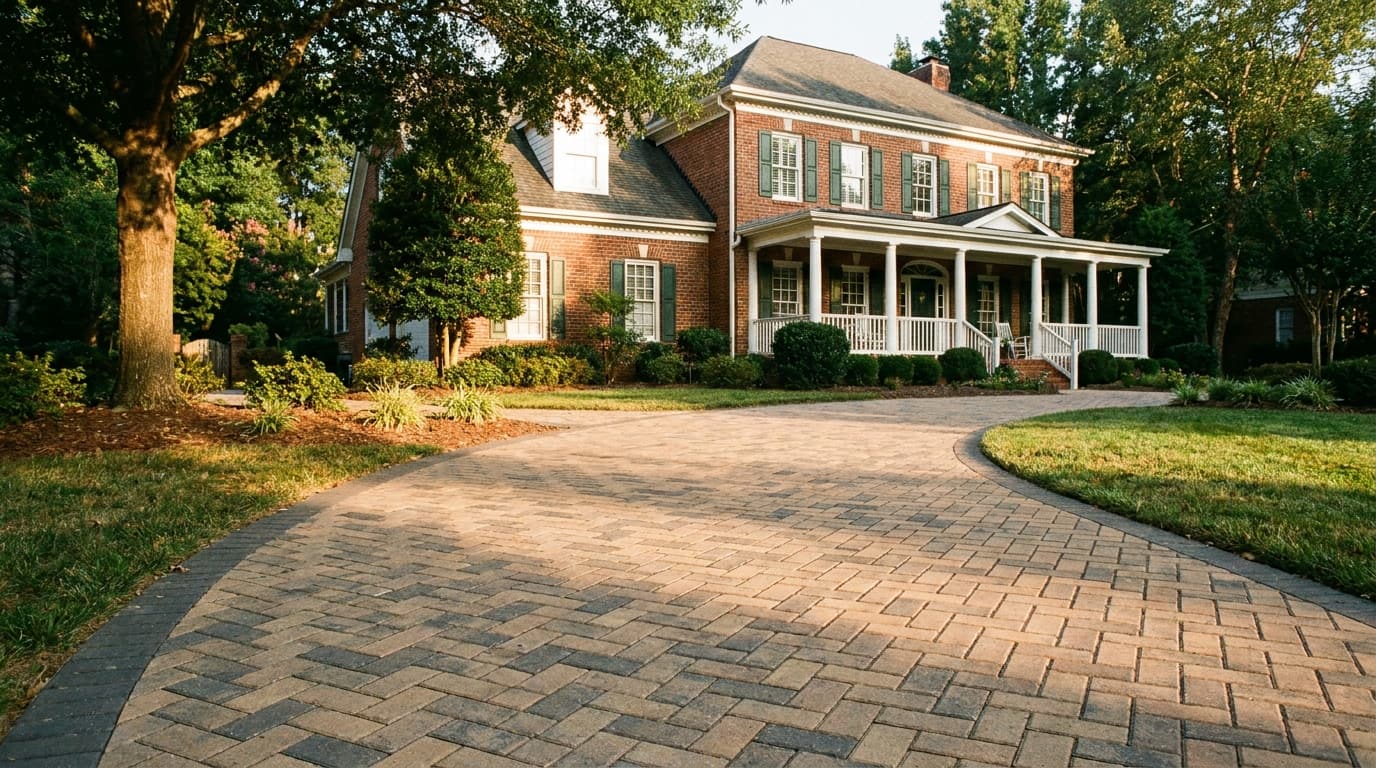
Charlotte has more red brick per square mile than almost any city we work in — Colonial and Georgian-style homes from Myers Park to Waxhaw, plus decades of brick ranches spread across Mecklenburg and Union County. That means paver color isn't just a style choice here; it's the difference between a driveway that looks like it was designed for the house and one that looks like it was dropped in from a catalog. We've installed enough driveways and patios next to red brick and clay-tone siding to know which paver families work, which ones fight the house, and how North Carolina's red clay actually changes the way a color reads over time.
Why paver color matters more next to brick than next to siding
Brick has a fixed, permanent color the day it's fired, and it doesn't move — no repainting, no fading the way stucco or vinyl siding does. That means the paver color has to work with the brick indefinitely, not just for one season. A gray paver next to a warm red-orange brick can look cold and disconnected, while the wrong tan can wash out and make both surfaces look flat. We treat brick as the fixed anchor color and build the paver blend around it, not the other way around.
Color families that complement red brick
Warm charcoal, clay, and tan-buff blends are the most reliable choices next to Charlotte's red brick homes. A three-tone blend running from a soft tan base through a mid clay tone into a charcoal or dark brown accent picks up the undertones already in the brick without matching it exactly — matching too closely tends to make the driveway disappear into the house instead of framing it. Charcoal alone, used as a border or soldier course around a tan field, is one of our most requested combinations because it reads as intentional contrast rather than an accident.
Color families that clash with red brick
Cool grays, blue-grays, and stark white pavers are the combinations we steer clients away from. A cool gray paver next to warm red brick creates a visible temperature clash — the brick looks warmer and the paver looks colder, and the eye picks up on that mismatch even if the homeowner can't immediately say why the driveway looks off. Bright white or very light beige pavers also tend to overexpose next to darker brick, making the brick look dingy by comparison rather than rich.
How red clay dust and staining change color choice
Mecklenburg and Union County soil is famous for its red clay, and that clay doesn't stay in the yard — it tracks onto driveways, walkways, and patios, especially near planting beds and during construction season. Lighter tan and buff pavers show clay staining faster than mid-tone blends do, which is one of the practical reasons we lean toward clay-and-charcoal blends for driveways specifically: the color of the paver already sits close to the color of the stain, so tracked-in clay is far less visible day to day. A pure white or very pale gray driveway in a Charlotte-area yard with exposed clay beds often needs pressure washing every 6-8 weeks just to look clean; a clay-toned blend can go months longer between washes.
Blending multiple tones vs a single color
A single-color paver field looks clean in a showroom photo but tends to look flat and uniform once it's installed at full scale in real light — every paver reads exactly the same, so shadows and texture do all the work. A three-to-four color blend, laid randomly rather than in a repeating pattern, creates natural variation that reads more like natural stone and hides small imperfections like a slightly uneven paver edge or a minor color lot difference between pallets. For a home with strong brick color, we usually recommend a blend for the main field and reserve a single accent color for borders, bands, or a fire pit surround.
Testing color before committing
Because paver color reads differently in full sun, shade, and against your specific brick, we always lay out a sample panel — usually about 4x4 feet — directly against the house before ordering the full material. Photos and manufacturer samples under indoor lighting consistently look different than the same pavers sitting in your actual driveway at 3pm. This one step has saved more than one Charlotte client from ordering a full pallet of a blend that looked right online and wrong on-site.
A real Charlotte scenario: color blend for a brick ranch in Waxhaw
A homeowner in Waxhaw had a 1990s red brick ranch with a builder-grade concrete driveway they wanted replaced with pavers, plus a small front walkway. Their first instinct was a light gray paver they'd seen on a neighbor's newer stucco home, but the brick on their house ran a deep red-orange with visible clay undertones. We laid out three sample panels against the house — a cool gray, a straight tan, and a tan-clay-charcoal blend — and the blend was the clear winner once they saw it against the actual brick in afternoon light. Here's roughly how the driveway and walkway priced out:
- Demo and haul-off of old concrete driveway: $2,600
- Excavation and base prep (450 sq ft driveway + 60 sq ft walkway): $2,900
- Tan-clay-charcoal blended pavers, driveway field: $6,800
- Charcoal soldier border, driveway and walkway: $2,100
- Labor, polymeric sand, sealing: $2,900
- Total: ~$17,300
The client told us afterward that the sample panel step was what convinced them — the gray they'd originally picked would have fought the brick for as long as they owned the house.
Frequently Asked Questions
Warm tan, clay, and charcoal blends generally work best next to Charlotte's red brick homes. These tones pick up the warm undertones already in the brick instead of competing with them. Cool grays and stark white tend to clash because they read as visually "colder" than warm red-orange brick.
No — matching too closely usually makes the driveway visually disappear instead of framing the house. A blend that complements the brick's undertone without duplicating it, often with a slightly darker accent border, reads as more intentional and higher-end than a direct match.
Yes. Light tan and buff pavers show tracked-in red clay noticeably faster than mid-tone or charcoal-heavy blends, since the stain contrasts more against a pale surface. Homeowners with light-colored driveways in Charlotte-area clay soil often need to pressure wash every 6-8 weeks to keep the color looking clean.
Yes, and we include this as a standard step. Paver color reads differently under indoor lighting, on a manufacturer's sample chip, and against your actual brick in real sunlight. A small on-site sample panel, usually laid out before material is ordered, prevents committing to a full driveway's worth of the wrong blend.
Planning something similar? See how we approach paver patio installation in Charlotte and the surrounding metro, or find your town in our service area.
Get a Free Estimate
If you want help picking a paver blend that actually works with your home's brick instead of guessing from a catalog photo, we'll bring samples out and lay them against your house before you order anything.
Get a Free Estimate
.jpg)