A leaning retaining wall is one of the most common calls we get, and the question every homeowner asks first is the same: can this be fixed, or does the whole thing need to come down. The honest answer depends on how far the wall has moved, why it moved, and how much of the wall is affected — and getting that diagnosis right before spending money is the difference between a $2,000 fix and an $18,000 wall you didn't need to lose. We've walked into plenty of estimates where a homeowner had already braced for a full rebuild based on how the wall looked, only to find out the underlying structure was still sound and a fraction of that budget would solve it.
The first measurement that matters: how far out of plumb
We start every leaning wall inspection with a level and a tape measure, not a guess. A wall that's leaned less than about 1 inch out of plumb per foot of height is often still salvageable with repair. Once a wall exceeds roughly 2 inches out of plumb per foot of height, or has visibly rotated at the base, the blocks or stones have typically shifted enough that the original interlock or footing is compromised, and repair stops being a realistic option — at that point you're not fixing the wall, you're temporarily propping up a structure that's already failed.
Signs the wall is failing, not just settling
- Horizontal cracks running the length of the wall, especially near the base, which usually indicate the footing has shifted
- Bulging in the lower third of the wall face, a sign the soil pressure is pushing the wall out from the bottom rather than the top
- Gaps opening between blocks or stones that weren't there when the wall was built
- Water actively seeping or pooling at the base of the wall after rain, which points to a drainage failure that's actively making the lean worse
- Sudden movement after a heavy rain event, rather than gradual movement over years, which suggests the wall took on hydrostatic pressure it wasn't built to handle
Any one of these on its own is worth a look. Two or more together usually means the wall has already crossed from "monitor it" to "act on it soon."
When a repair genuinely fixes the problem
If the lean is minor, isolated to a short section, and traced to a clear cause — most often trapped water behind the wall or a small area of base settlement — a repair can address the actual cause without rebuilding the whole structure. A typical repair involves regrading the soil above the wall so water sheds away from it instead of into it, adding or clearing a drain at the base, and in some cases resetting the top one or two courses of block or stone that have shifted. This works because the structural core of the wall — the base course and the buried footing — is still sound; only the surface symptoms need correcting.
When a full rebuild is the only real fix
Once the base course has rotated, the footing has washed out, or the lean has progressed past that roughly 2-inch-per-foot threshold, patching the visible part of the wall doesn't change the fact that the foundation underneath it has already failed. Rebuilding means full excavation, removing the compromised courses (sometimes the whole wall), correcting drainage from the footing up, and rebuilding with proper base compaction, drainage stone, and — on taller walls — geogrid reinforcement tied back into stable soil. It's a bigger job, but it's the only way to actually stop the movement rather than delay it.
Cost comparison
- Drainage and regrade repair (isolated section, wall still structurally sound): typically $1,800-$4,500 depending on wall length and how much regrading is involved.
- Partial rebuild (10-20 linear feet of a longer wall, base still sound): typically $5,500-$9,500.
- Full rebuild: typically $45-$70 per square foot of wall face, which for a 30-foot wall averaging 4 feet tall lands in the $5,400-$8,400 range, and climbs from there with taller walls or engineering requirements.
The gap between a repair and a rebuild is real money, which is exactly why getting the diagnosis right matters more than acting fast.
Timeline for each approach
A drainage and regrade repair on an isolated section typically takes 1-2 days. A partial rebuild of a section runs 3-5 days depending on access and how much of the wall needs to come out. A full rebuild of a wall in the 30-40 foot range typically runs 6-10 days from demolition through backfill and capping, plus additional time if an engineer's design and a permit are required for the height.
A real Charlotte scenario: a Weddington wall
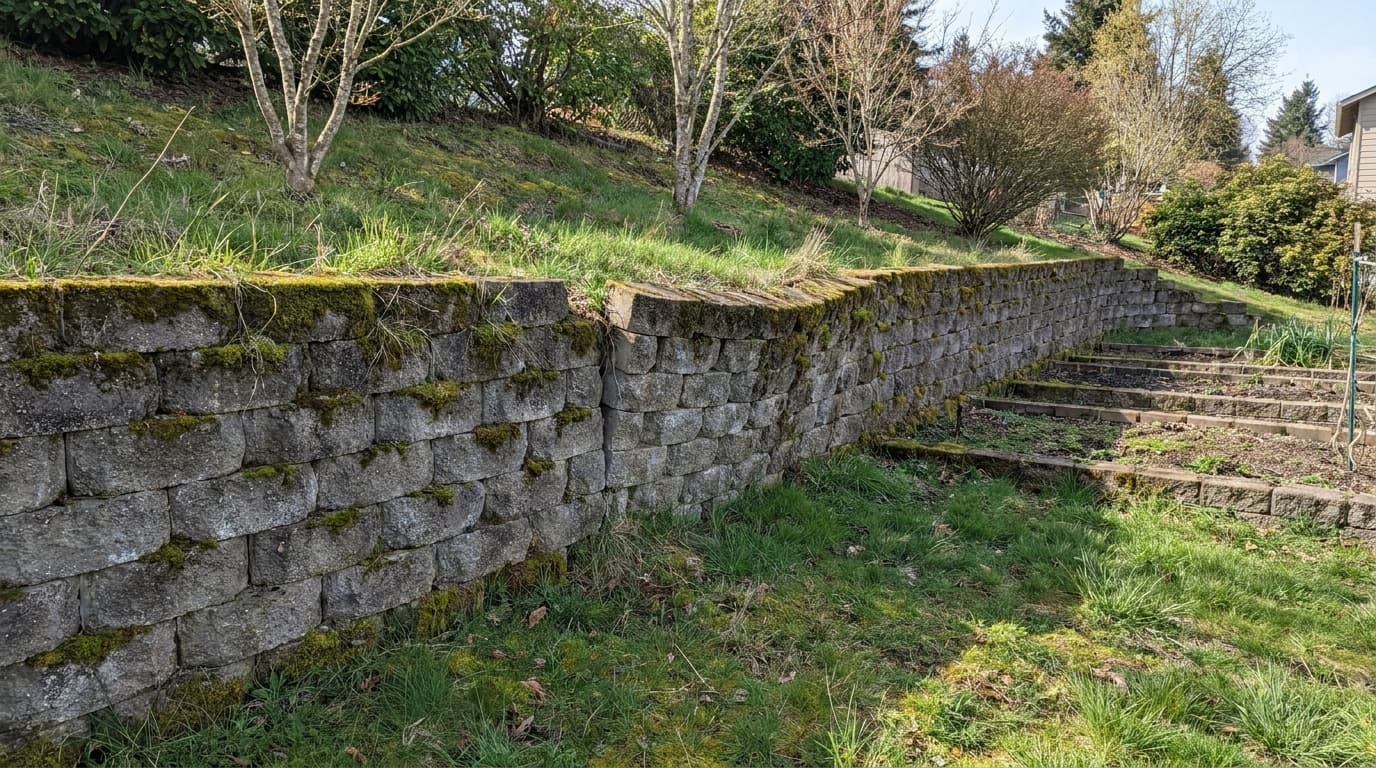
A homeowner in Weddington called us about a 45-foot segmental block wall along their driveway that had a section leaning noticeably after a wet spring. We measured the lean at about 3 inches out of plumb over a 4-foot wall height in the worst section — well past the point where a surface repair would hold. Excavating that section showed the base course had actually rotated forward and the footing gravel had washed out from underneath, likely from a downspout that had been discharging directly behind the wall for years. We rebuilt 16 feet of the wall from the footing up, redirected the downspout to daylight well past the wall, and added drainage stone and a perforated pipe behind the rebuilt section. That work came to $6,800, compared to an estimate of roughly $22,000 to rebuild the entire 45-foot wall, since the remaining 29 feet tested solid and stayed in place.
Frequently Asked Questions
If the wall is over 4 feet tall, if the repair involves rebuilding a significant section, or if the local jurisdiction's height threshold applies to your wall, an engineer's design is typically required as part of the permit. We flag this during the inspection before you commit to a repair or rebuild plan.
It depends on what's above and below it. A leaning wall under a driveway, patio, or near a structure carries real risk if it fails suddenly, and the movement tends to accelerate rather than stop on its own once drainage is compromised. A wall in an open yard with nothing critical nearby carries lower immediate risk but will still continue to worsen.
No — adding weight or soil behind a leaning wall increases the load pushing on an already compromised structure and can speed up failure rather than mask it.
Typically not, since retaining wall failure from water pressure or age is generally treated as a maintenance issue rather than a covered peril. Some policies do cover sudden collapse in specific circumstances, so it's worth checking your policy, but budget for the repair as an out-of-pocket cost.
Planning something similar? See how we approach paver patio installation in Charlotte and the surrounding metro, or find your town in our service area.
Get a Free Estimate
If your wall is leaning, we'll measure it, tell you honestly whether it's a repair or a rebuild, and give you an itemized price either way.
Get a Free Estimate