When a Charlotte yard needs to hold back a slope, most homeowners land on one of two very different systems — natural boulders stacked by gravity, or manufactured segmental block interlocked in engineered courses. Both retain soil, but the way they do it, what they cost, and how they look are different enough that picking the wrong one for your yard usually shows up as regret within a season. We build both regularly, and the right choice almost always comes down to the same handful of factors: the slope itself, the equipment access on the lot, the budget, and the style of the house and landscape the wall has to sit next to.
How each system actually holds the soil
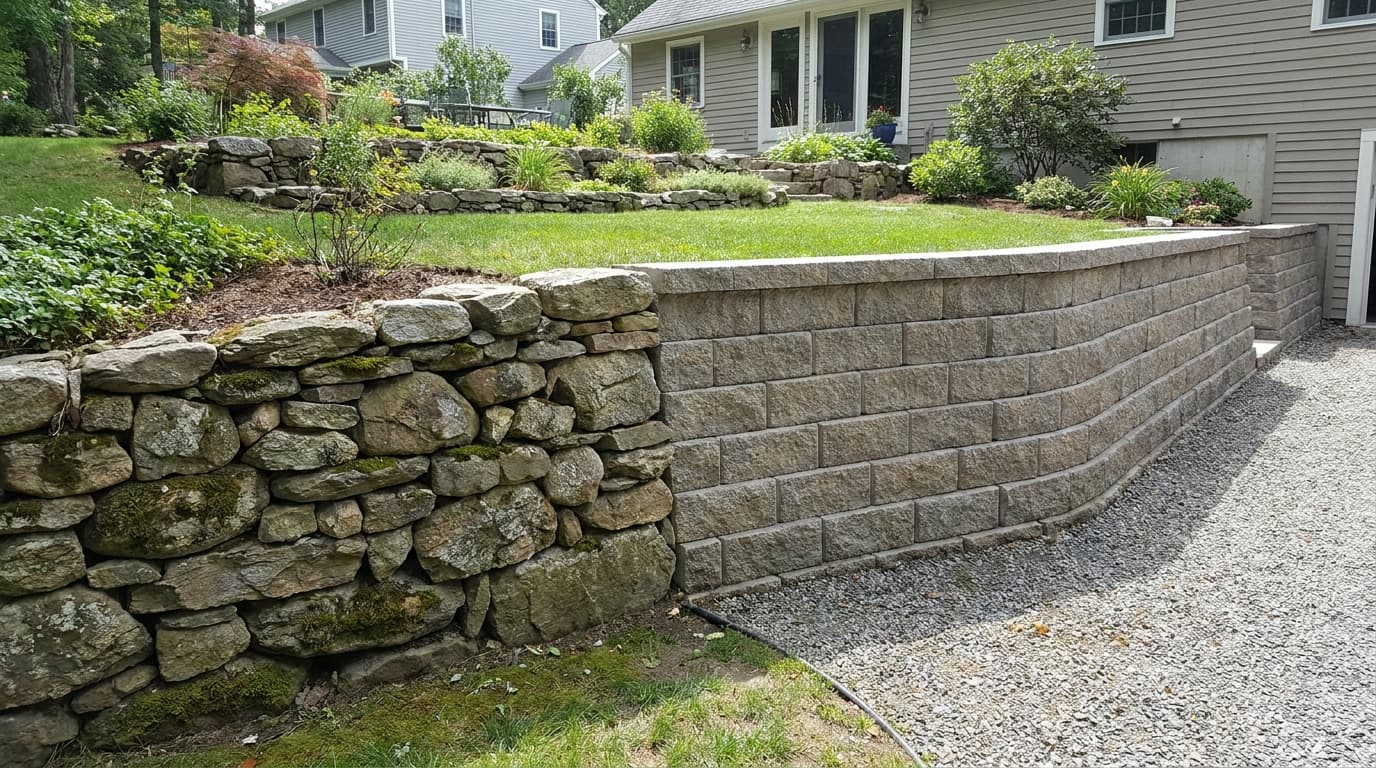
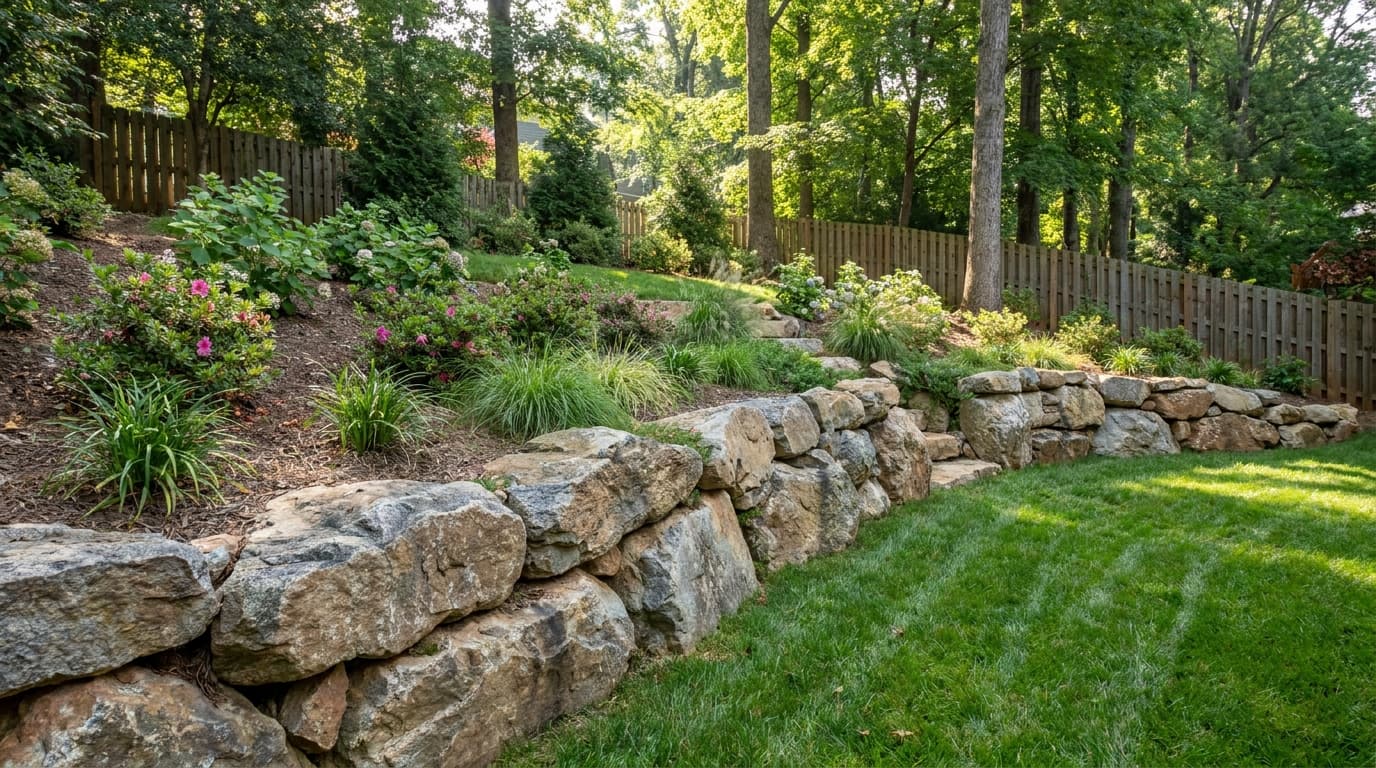
A boulder wall works on sheer mass and friction. Large stones, often in the 1-4 ton range for the base course, are set into the slope and stacked so each stone's weight and batter (backward lean into the hill) resist the soil pressure behind them. There's no mechanical connection between stones — the wall stays up because gravity and geometry keep it there. A segmental block wall works differently: manufactured concrete units interlock via lips, pins, or textured contact surfaces, and the wall relies on that interlock plus geogrid reinforcement extending back into the soil on taller walls to resist the same pressure. It's an engineered system built from a much smaller, uniform unit rather than a handful of massive stones.
Cost per linear foot
- Boulder walls typically run $45-$85 per square foot installed in the Charlotte market, with the range driven heavily by stone size, sourcing distance, and how much equipment access the site allows. Boulders in the 2-3 ton range require an excavator with enough reach to place them precisely, and that equipment cost carries into the price.
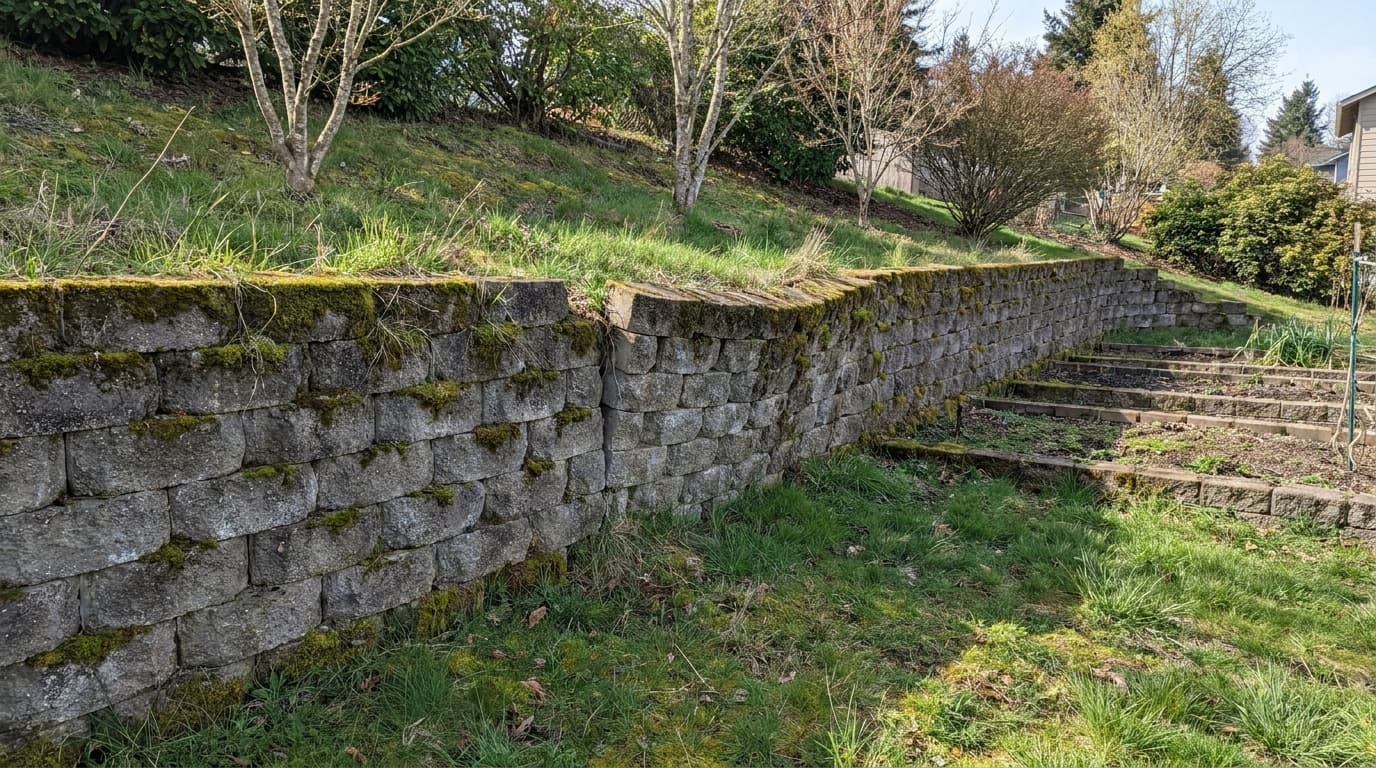
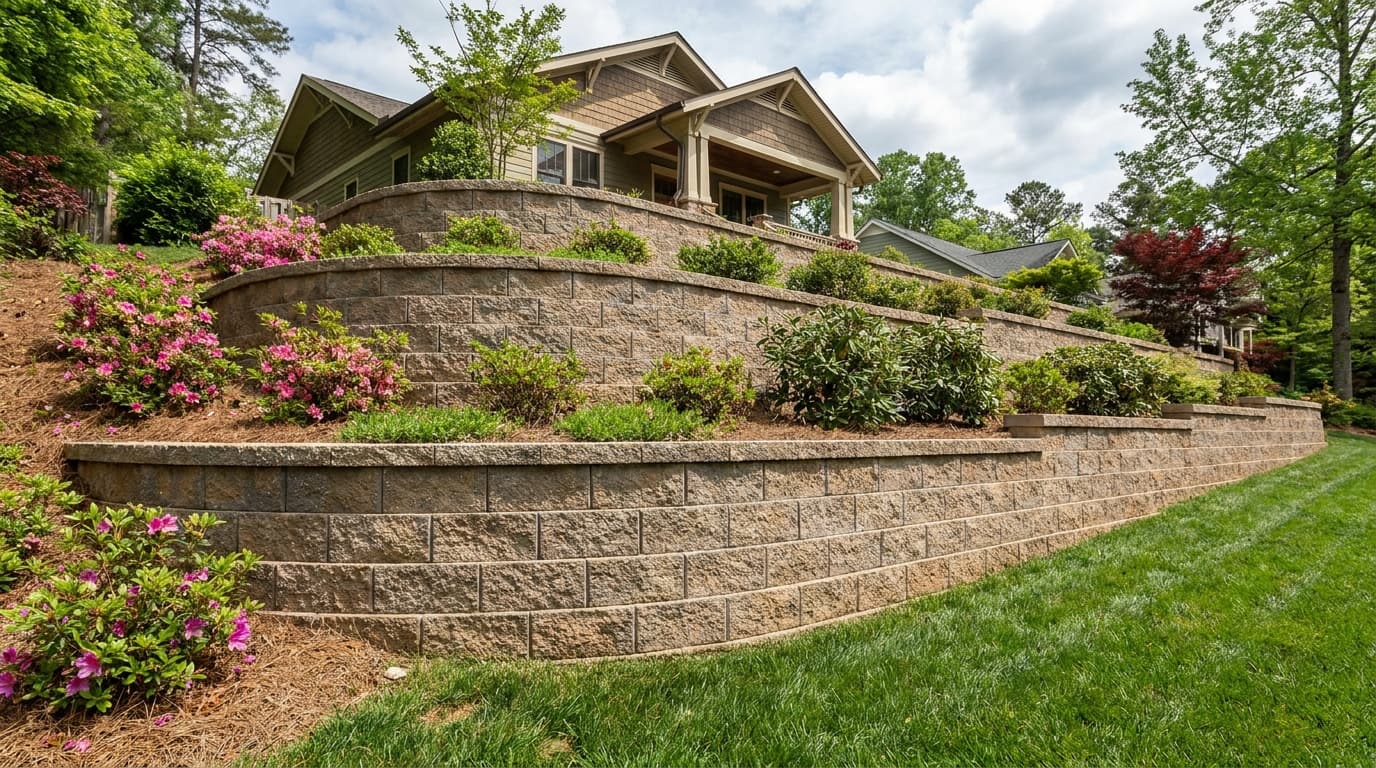
- Segmental block walls typically run $25-$45 per square foot installed, depending on block style, wall height, and whether geogrid reinforcement is required. Blocks are lighter, palletized, and faster to set, which keeps labor hours per square foot lower than boulder placement.
For a straightforward 40-foot wall averaging 3 feet tall, that difference is roughly the gap between an $8,000 segmental block wall and a $14,000-$16,000 boulder wall of comparable footprint.
Height limits without an engineer
Both systems have a practical height where an engineer's stamp becomes necessary for the design, but the number differs for each. Segmental block gravity walls (no geogrid) generally top out around 3-4 feet before reinforcement or engineering is needed, since above that the interlock alone can't resist the soil pressure. Boulder walls, because of their sheer mass, can sometimes go slightly taller on a gravity basis alone — but the tradeoff is that a taller boulder wall needs proportionally larger stone at the base, and stone that large gets expensive and hard to source and place quickly. In practice, most unengineered boulder and block walls we build in Charlotte stay in the 3-5 foot range, and anything taller gets an engineer involved regardless of material. This is also where geogrid comes into the picture for block: adding horizontal reinforcement layers tied back into the compacted soil behind the wall lets a segmental block system safely go well past that unreinforced 3-4 foot ceiling, which is why most of the taller block walls we build carry geogrid even when the county doesn't require an engineer's stamp for the height.
Installation complexity and site access
Boulder walls need real equipment access — a track excavator sized to lift and place multi-ton stone has to be able to reach the wall line, which rules out or complicates boulder walls on tight urban lots with narrow side-yard access. Segmental block can often be built with hand-carried or small equipment in spaces a full-size excavator can't reach, which is one reason block shows up more often on infill lots close to the street or in backyards with no drive-around access.
Maintenance and long-term behavior
Segmental block walls hold a straighter, more consistent line over time because the units are uniform and the interlock resists individual-unit movement. Boulder walls can settle slightly as individual stones find their final resting position over the first year or two after installation, which is normal and rarely a problem, but it does mean a boulder wall's face is never perfectly flat the way a block wall's is — that's part of the look, not a flaw. Neither system requires regular maintenance beyond keeping drainage clear and watching for erosion at the base or top of the wall after heavy rain.
Which fits which yard
Boulder walls read as part of the landscape rather than a built structure, which makes them the natural fit for wooded lots, naturalistic planting beds, walls near a creek or drainage feature, or any yard where the goal is for the wall to look like it's always been there. Segmental block reads as architecture — clean lines, consistent coursing, and color options that can be matched or contrasted with a home's exterior — which makes it the stronger fit for more formal landscapes, pool surrounds, and modern or transitional homes where a crisp geometric line is the goal.
A real Charlotte scenario: a Dilworth backyard
A homeowner in Dilworth came to us with a sloped backyard dropping about 3.5 feet over 30 feet of run, right where they wanted a flat lawn area for their kids. The lot backed up to mature trees and had a naturalistic planting style already established, so a boulder wall was the better fit visually, but the side-yard access to the backyard was only about 4 feet wide — too narrow for a full-size excavator. We used a compact track excavator that could fit through the gate and sized the boulders down to the 800-1,200 pound range instead of the 2-3 ton stone we'd normally spec, which kept the wall buildable without losing the natural stacked look. The 32-foot wall came in at $11,400, roughly 20% above what an equivalent segmental block wall would have cost on that footprint, but it matched the yard in a way block couldn't have.
Frequently Asked Questions
Not inherently — strength depends on engineering and installation, not material. Both systems, built correctly for the height and soil conditions, hold up reliably; taller walls of either type need geogrid reinforcement or an engineer's design regardless of material choice.
Yes, and it's a common approach — using segmental block for a formal wall near the house or patio and boulders for a more naturalistic wall further back in the yard is a way to get both looks without one material fighting the other.
A boulder wall generally takes longer per linear foot because each stone is individually placed by hand-signaling the excavator operator, whereas block courses go in faster once the base is prepped. A 30-40 foot wall typically runs 3-5 days for boulders versus 2-3 days for comparable segmental block.
Planning something similar? See how we approach paver patio installation in Charlotte and the surrounding metro, or find your town in our service area.
Get a Free Estimate
Tell us your slope, your yard's style, and what access we're working with, and we'll recommend the wall system that actually fits — then price it out.
Get a Free Estimate