"Natural stone" and "manufactured block" aren't just two colors of the same wall — they're built with different methods entirely, and that difference shows up in cost, durability, and how the finished wall reads in a Charlotte yard. Picking between them comes down to more than which one looks nicer in a photo, and it's one of the first questions we walk through with a client before pricing any retaining wall project, since the material decision drives the labor, the timeline, and the maintenance conversation that follows.
Two very different building methods
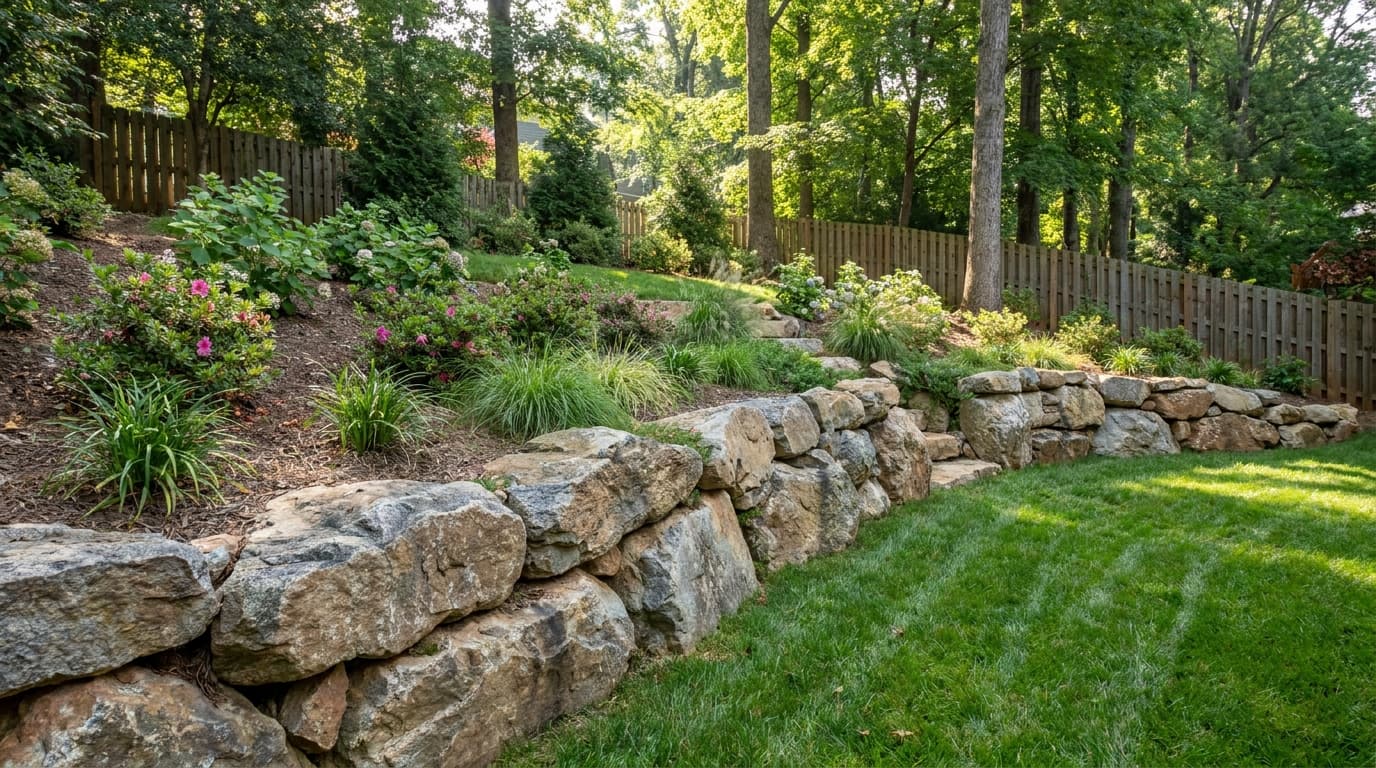
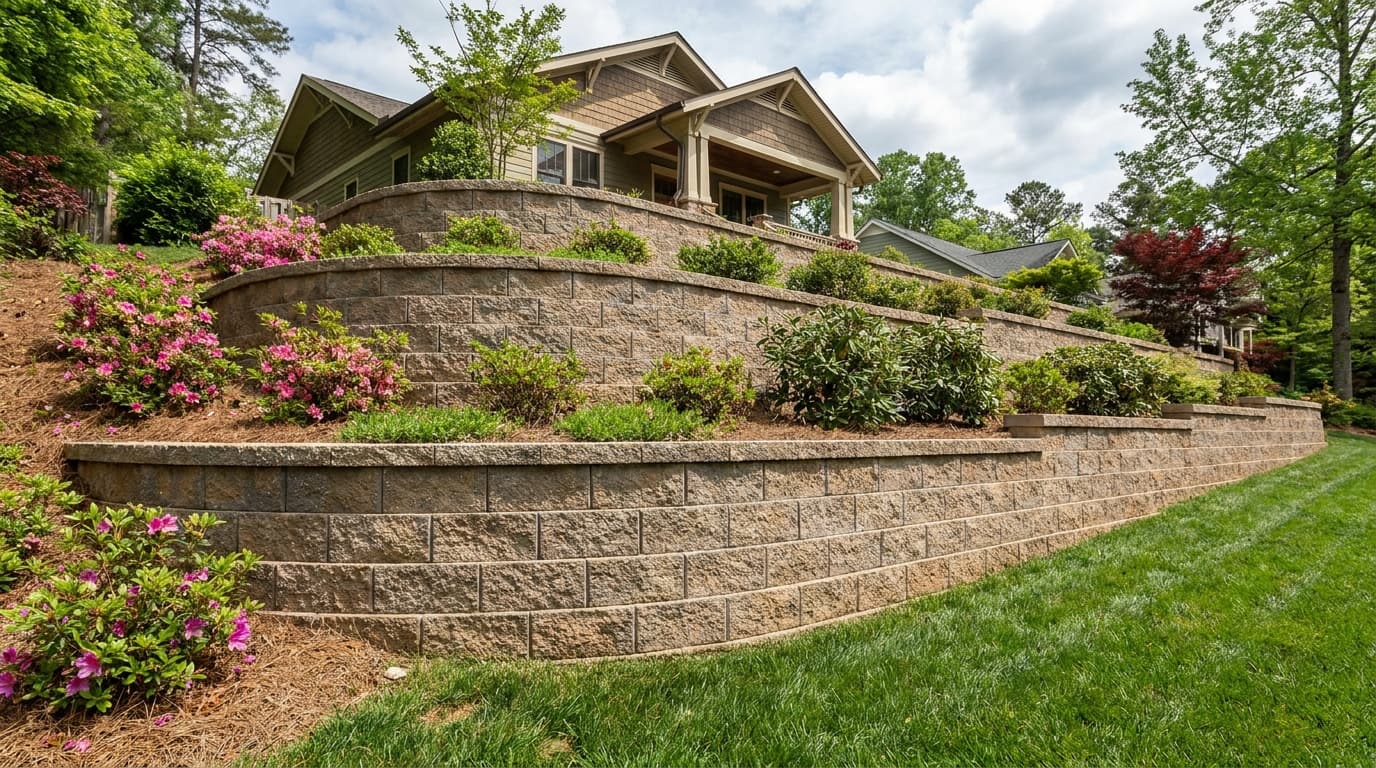
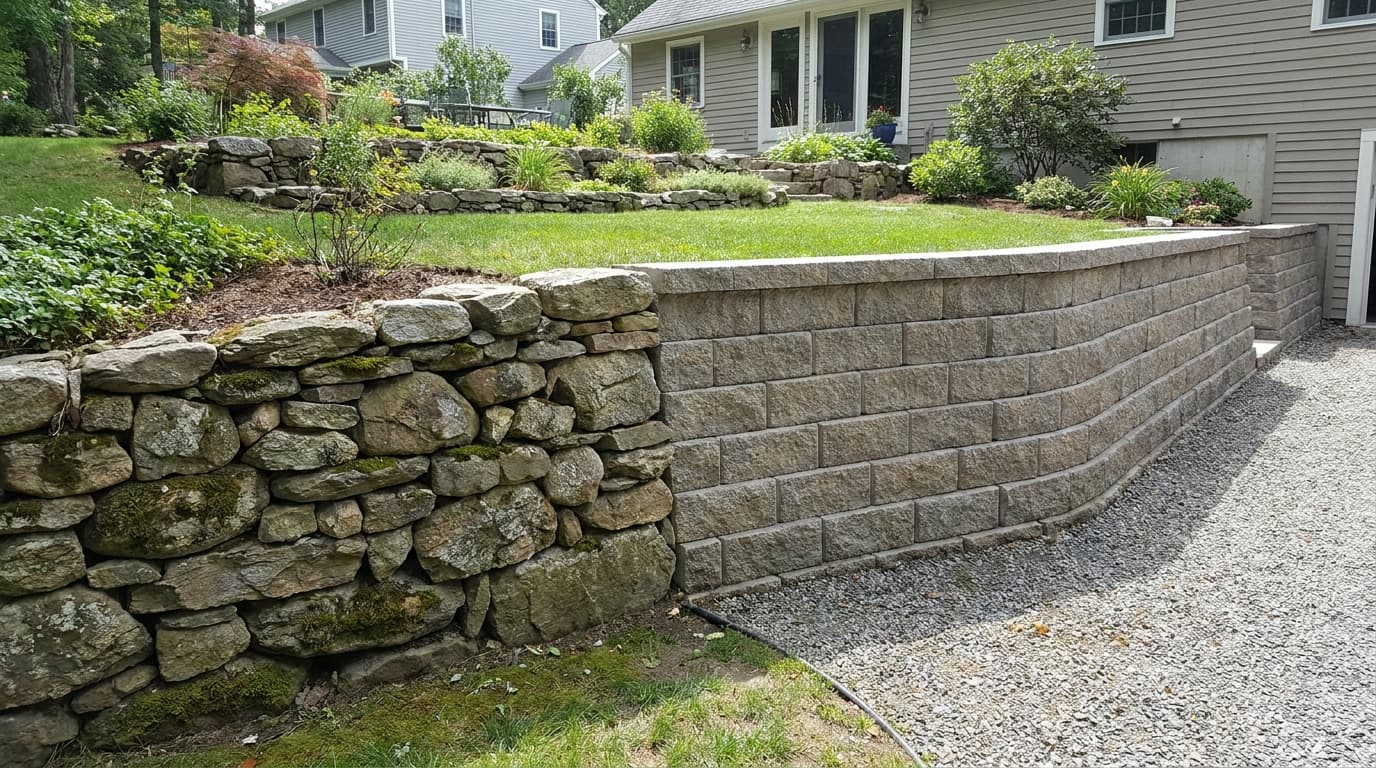
A natural stone wall is built from irregular fieldstone, each piece hand-selected and hand-fit to the pieces around it, either dry-stacked (no mortar, relying on friction and fit) or mortared for extra rigidity. A manufactured block wall uses uniform concrete units, molded to interlock precisely, that go together in level courses without any custom fitting. One is closer to stonemasonry; the other is closer to engineered construction with a natural-stone-look face. Some manufactured block lines also offer a textured, tumbled face specifically designed to visually approximate cut stone, which is worth knowing about if budget rules out true fieldstone but the homeowner still wants a stone-adjacent look.
Cost comparison
- Natural stone (fieldstone, mortared or dry-stacked) typically runs $55-$95 per square foot installed, with the range driven by stone type, how much hand-fitting the wall requires, and whether it's mortared.
- Manufactured segmental block typically runs $25-$45 per square foot installed.
The gap comes almost entirely from labor. A mason fitting irregular stone by hand covers far less wall face per day than a crew setting uniform block, and that labor time is most of what you're paying for with natural stone. Material cost plays a smaller role than most homeowners expect — quality fieldstone and quality block are both reasonably priced per ton or per unit delivered; it's the hours spent placing each one that separates the two totals.
Freeze-thaw performance in Charlotte's clay
Charlotte gets real freeze-thaw cycling — not as harsh as the mountains or the Northeast, but enough winters with nights below freezing and days above it that moisture in the wall system expands and contracts repeatedly each season. This matters more for the soil behind the wall than for the stone or block itself: both materials handle freeze-thaw fine on their own, but saturated NC clay behind a wall expands measurably when it freezes, and that expansion pushes on the wall face regardless of what it's built from. Where the materials actually diverge is at the joints — a mortared stone wall with poor drainage can see mortar joints crack under repeated freeze-thaw pressure over the years, since mortar is rigid and doesn't flex with minor movement. A dry-stacked stone wall or a segmental block wall has no rigid mortar joint to crack, so minor seasonal movement gets absorbed rather than fractured. This is one reason we lean toward dry-stack or veneer-over-block construction rather than fully mortared stone walls for anything holding back real grade in this region. When a client wants the mortared look for a specific architectural reason, we compensate with a more robust drainage system behind the wall — more drainage stone, a properly sloped perforated pipe, and careful attention to the base — so the freeze-thaw cycle has less saturated soil to work against in the first place.
Labor complexity and build time
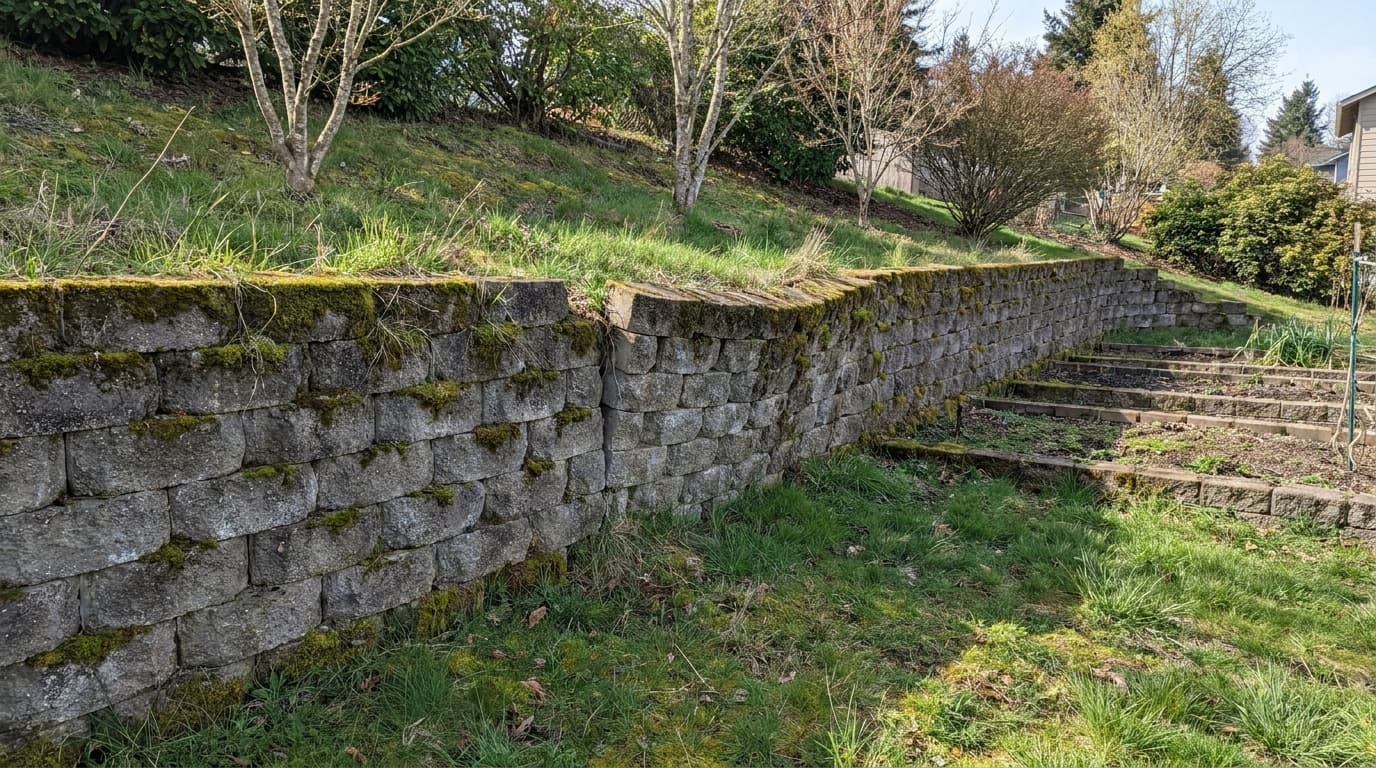
A segmental block wall follows a repeatable system — base prep, first course leveled and checked, subsequent courses interlocked and backfilled in stages. A crew experienced with the system can move through 15-20 linear feet a day on a straightforward wall. A natural stone wall requires sorting stone by size and shape before building even starts, then fitting each piece to minimize gaps and keep the face relatively even — something that can't be rushed without the wall looking sloppy or the joints being structurally weak. That typically limits progress to 6-10 linear feet a day for a skilled mason, which is the other half of why natural stone costs more: it simply takes longer to build correctly. On a longer wall, that pace difference compounds — a 40-foot wall that takes a block crew two to three days can realistically take a stone mason a full week or more, which is worth planning around if a project has a hard completion date.
Which fits which home
Manufactured block reads clean and consistent, which suits contemporary, transitional, and many craftsman-style homes where the exterior itself has crisp lines. It's also easier to color-match or contrast intentionally against siding or brick since block comes in a controlled range of manufactured colors. Natural stone reads as timeless and site-specific — no two stones are identical, so the wall has texture and variation that manufactured product can't fully replicate — which is why it tends to fit older, traditional, colonial, and estate-style homes, or any lot where the goal is a wall that looks like it belongs to the land rather than a product installed on top of it.
Longevity and repair down the road
Both systems, built correctly with proper base and drainage, last decades. The practical difference shows up in repair: a damaged segmental block wall can usually be repaired by pulling and resetting the affected units, since replacement block of the same style is often still available or close enough to match. A damaged natural stone wall repair depends on whether matching stone is available — since fieldstone is sourced, not manufactured, a repair years later may require sourcing stone from the same quarry or a close match, which isn't always straightforward.
A real Charlotte scenario: an Eastover front yard wall
A homeowner in Eastover with a classic brick colonial wanted a low wall, about 2.5 feet at its tallest point, framing a front planting bed along the driveway. Given the home's traditional architecture, we built it in dry-stacked fieldstone rather than block, sourcing stone with warm tan and gray tones to complement the brick. The 38-foot wall came to $8,200, versus an estimate of roughly $3,400 for the same footprint in manufactured block. The homeowner was clear from the start that the block price wasn't the point — the stone wall reads as part of the house's original character in a way block couldn't have, and that was worth the difference to her.
Frequently Asked Questions
Not necessarily. Both materials, built with proper base preparation and drainage, commonly last 30-50 years or more. Longevity depends far more on the build quality and drainage behind the wall than on the material itself.
Some higher-end block lines are textured and colored to mimic natural stone at a glance, and from a distance they can read fairly close. Up close, the uniformity of manufactured block — repeating shapes and identical texture — is usually still noticeable next to true fieldstone's irregularity.
For a properly engineered gravity wall, yes, and in freeze-thaw climates like Charlotte's, dry-stacked or veneer construction actually holds up better over time since there's no rigid mortar joint to crack under seasonal movement.
Planning something similar? See how we approach paver patio installation in Charlotte and the surrounding metro, or find your town in our service area.
Get a Free Estimate
Whether you're leaning toward natural stone or manufactured block, we'll walk your yard and give you real pricing for both before you decide.
Get a Free Estimate