
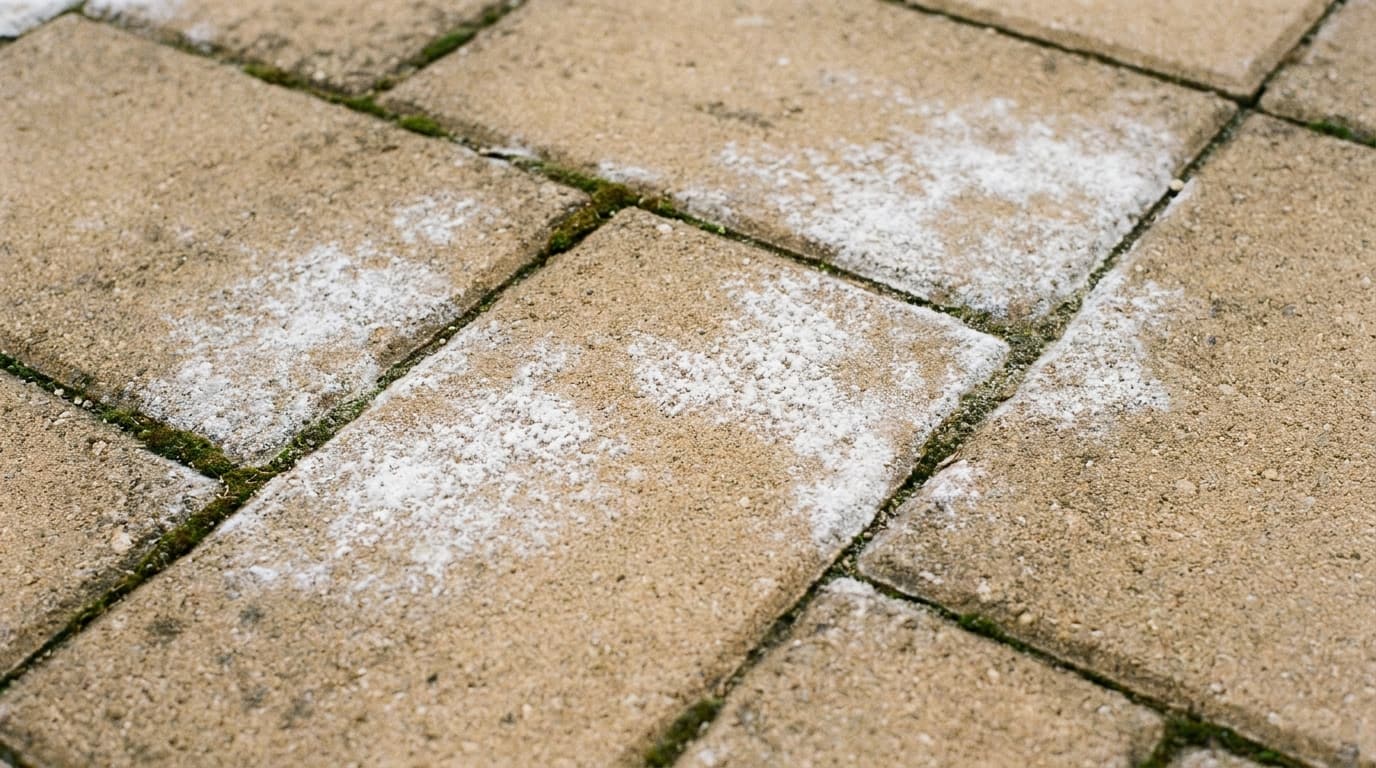
New pavers in Charlotte almost always develop a light white haze within the first few months after installation, and it catches almost every homeowner off guard — the driveway or patio that looked flawless on install day suddenly looks dusty even though nothing has touched it. That haze is efflorescence, and while it looks alarming, it's a normal chemical byproduct of the concrete curing process, not a manufacturing flaw or a sign the pavers were installed wrong. We field calls about it almost weekly during the spring and early summer, right after the first real stretch of wet weather following a winter or early-spring install.
What efflorescence actually is
Concrete pavers are made with portland cement, and portland cement contains calcium hydroxide as a byproduct of the curing reaction. When moisture inside the paver — from rain, irrigation, or ambient humidity — dissolves that calcium hydroxide and carries it to the surface, the water evaporates and leaves the calcium behind. That calcium reacts with carbon dioxide in the air and converts to calcium carbonate, a fine white mineral deposit that sits on the paver's face. It's the same basic process that forms limescale in a kettle, just happening inside a slab of concrete instead of a pot of water. The joint sand between pavers is cement-based too on most polymeric sand products, so it's common to see the haze concentrated right along the joint lines before it spreads across the paver face itself.
Why it shows up so much on new installations
Efflorescence is almost always heaviest in the first 6-12 months after a paver driveway or patio goes in, because that's when the concrete still holds the most residual moisture from curing. As pavers dry out over their first year or two, the amount of soluble calcium hydroxide available to migrate to the surface drops off, and most installations see efflorescence fade substantially on its own. We tell every client the same thing at handoff: expect some haze in year one, and don't panic when you see it. Poured concrete slabs go through the exact same process, but it's less commonly noticed because a broom-finished driveway slab doesn't have the joint lines that make the haze visually obvious the way it is against the crisp edges of a paver pattern.
Why Charlotte's clay and rainfall make it worse
Two things about our region push efflorescence harder than in drier climates. First, the red clay base under most Charlotte lots holds water and drains slowly, so the sand setting bed and the base of the pavers stay damp longer after a storm than they would over sandy soil. Second, the Charlotte metro averages around 43 inches of rain a year, spread fairly evenly across the seasons rather than concentrated in one dry/wet split, which means pavers rarely get a long uninterrupted dry stretch to fully purge moisture. Both factors add up to more evaporation cycles pulling calcium to the surface, which is why we see some efflorescence on nearly every new install in this market. A properly built open-graded base with clean, angular stone underneath the bedding sand helps some, since it moves water through and away from the paver system faster than a dense, compacted base would, but it doesn't eliminate the process entirely — it just shortens how long it takes to settle down.
Is it a defect, or is it normal
Efflorescence is not a sign of a bad paver or a bad install. It's recognized industry-wide, including by the Interlocking Concrete Pavement Institute, as an inherent characteristic of portland cement products, and it happens whether pavers are laid by a licensed contractor or a DIY crew. What is a legitimate quality concern is efflorescence that never fades, gets heavier every year, or shows up alongside cracking or spalling — that combination usually points to a drainage problem underneath the pavers, not a curing byproduct, and it's worth having someone pull a unit and check the base.
How to remove existing efflorescence
- Dry brushing first. A stiff-bristle broom removes a surprising amount of light efflorescence dust without any chemicals at all, since the deposit sits loosely on the surface.
- Efflorescence cleaner. For haze that doesn't brush off, a dedicated efflorescence remover (a mild acid-based cleaner formulated for concrete) dissolves the calcium carbonate. We use products built specifically for pavers rather than general masonry cleaners, since some acids are strong enough to etch or discolor the paver face.
- Rinse thoroughly. Any acidic cleaner needs a full water rinse afterward, or it leaves its own residue behind.
- Avoid pressure-washing alone. A pressure washer can blast away surface dust but won't dissolve the mineral bond of heavier efflorescence, and too high a PSI on the joints can wash out the polymeric sand between pavers.
- Skip household vinegar and random masonry acids. They can work, but they're unpredictable on colored or coated pavers and can leave dulled or blotchy patches that are harder to fix than the original haze.
Sealing as prevention, not a fix
Sealing pavers does two things for efflorescence: it slows moisture penetration into the paver body going forward, and a good penetrating or film-forming sealer makes any future haze far easier to wipe off before it bonds hard to the surface. We don't recommend sealing immediately after install, though — sealing over pavers that are still actively curing and pushing moisture out can trap that moisture and make efflorescence worse underneath the seal. We wait a minimum of 60-90 days after installation, longer in a wet stretch, before applying sealer. On driveways and other high-traffic surfaces we generally lean toward a breathable, penetrating sealer rather than a heavy film-forming one, since a breathable finish still lets residual moisture escape gradually while giving the surface enough protection to keep future haze from bonding hard.
A real Charlotte scenario: a Myers Park patio
We installed a 480-square-foot paver patio in Myers Park in late winter, and by the following June the homeowner called concerned that the patio looked "dirty" despite regular sweeping. On inspection it was textbook efflorescence — a light, even haze across roughly 70% of the surface, heaviest near the low corner of the patio where water naturally pooled slightly before draining. We dry-brushed the surface, applied an efflorescence cleaner and rinsed it, and the patio came back to full color within about two hours of work. We held off on sealing until early September, giving the pavers a full spring and summer to finish curing, and applied a penetrating sealer at that point. The homeowner has not seen the haze return.
Frequently Asked Questions
It can, especially within the first year, since the pavers may still have unspent calcium hydroxide working its way out. Each occurrence is usually lighter than the last, and most installations stop producing new efflorescence within 12-18 months once the concrete has fully cured.
Not completely, since it's a byproduct of portland cement itself, but density matters. Higher-density, well-compacted pavers from quality manufacturers tend to show less efflorescence than lower-grade product, because there's less internal pore space for moisture to travel through.
Not by itself. Occasional, fading efflorescence is normal on a correctly built base. Efflorescence that's heavy, permanent, or paired with pooling water or shifting pavers is the combination that points to a drainage or base compaction issue underneath.
Yes. Efflorescence is a cosmetic surface deposit and has no effect on the structural strength or load capacity of the paver.
Planning something similar? See how we approach paver patio installation in Charlotte and the surrounding metro, or find your town in our service area.
Get a Free Estimate
If your driveway or patio has a haze that isn't fading or you want it professionally cleaned and sealed, we'll take a look and give you a straightforward plan.
Get a Free Estimate
.jpg)