
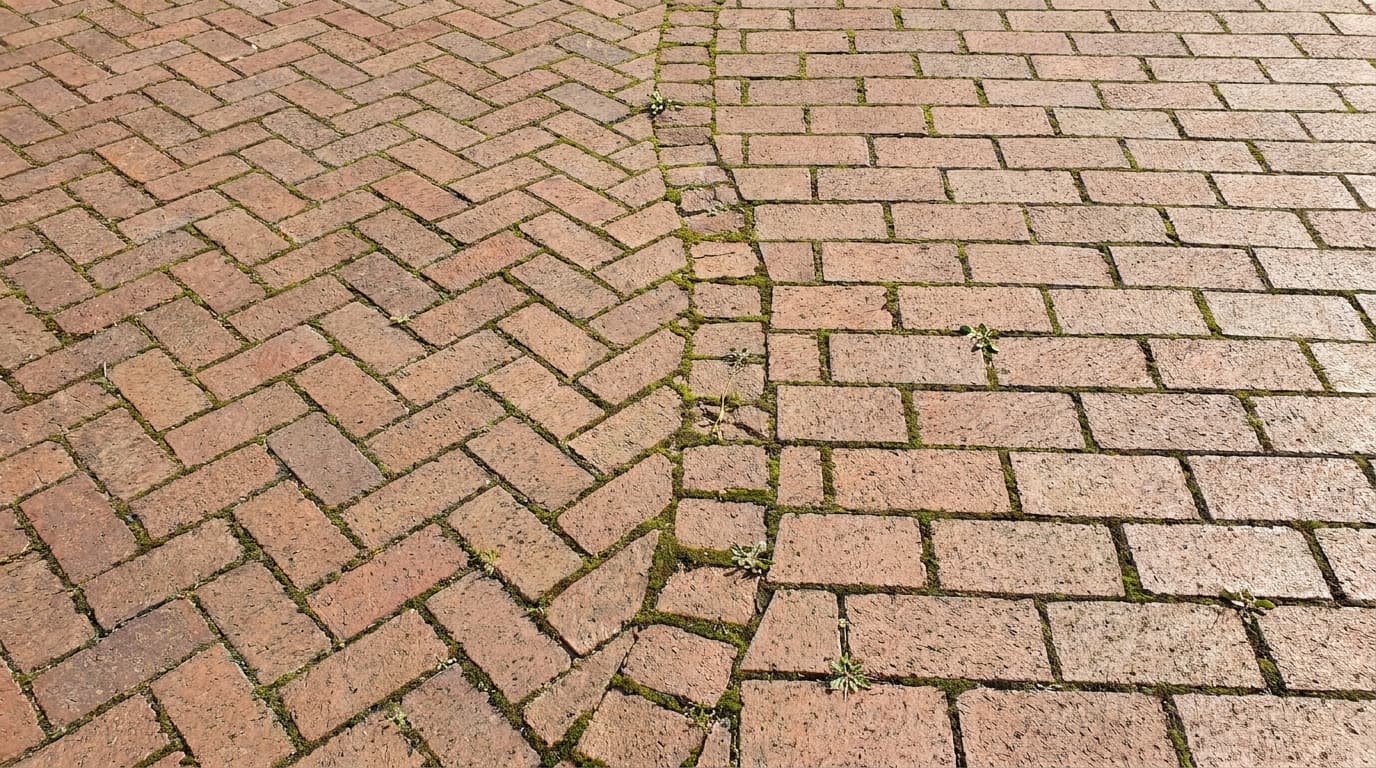
The pattern a paver is laid in isn't just a style decision — on a driveway, it's a structural one. We get asked constantly whether herringbone is "worth it" over running bond, and the honest answer depends entirely on what the surface has to hold up to. Here's the real difference between herringbone and running bond, where basketweave fits in, which pattern actually resists vehicle load and shifting, and what the labor cost gap looks like in practice.
What herringbone pattern actually is
Herringbone lays each paver at a 45-degree or 90-degree angle relative to the ones next to it, creating a zigzag interlock rather than straight running joints. That interlock is the whole point structurally — because no single line of joints runs straight through the pattern, the load from a tire or foot traffic gets distributed sideways into the surrounding pavers instead of concentrating along one joint line. It's the pattern almost every paver manufacturer recommends for driveways for exactly this reason.
What running bond pattern actually is
Running bond lays pavers in straight rows with each row offset by half a paver length from the one above it, similar to a classic brick wall pattern. It's clean, fast to lay, and reads as more formal or linear than herringbone. The tradeoff is that running bond has continuous straight joint lines running in one direction, which under repeated vehicle load can gradually creep or shift along those joint lines over time, especially without a properly compacted base and edge restraint.
Basketweave, briefly
Basketweave pairs pavers in twos, alternating horizontal and vertical pairs to create a woven look. It's a strong visual pattern for patios, pool decks, and walkways, but it isn't typically recommended for driveways — the pattern doesn't interlock as effectively as herringbone under directional rolling load, so it's better reserved for foot-traffic-only surfaces.
Which pattern actually holds up better under vehicle load
For a driveway specifically, herringbone is the stronger structural choice, and it isn't close. Manufacturers and paver industry associations consistently rate herringbone as the recommended pattern anywhere vehicles turn, brake, or accelerate, because the 45-degree interlock resists the lateral shear forces a turning tire creates far better than the straight joint lines in running bond. Running bond can still work on a driveway with excellent base prep and edge restraint, and we've installed it successfully for clients who wanted the look, but we're always upfront that it carries a higher long-term risk of joint creep in the wheel path specifically.
The labor cost difference
Herringbone takes longer to lay than running bond, mostly because of the cutting involved — every row against a border or edge needs angled cuts to fill the pattern cleanly, where running bond's straight rows need far fewer cuts. In practice, herringbone typically adds $1.50-$3.00 per square foot in labor compared to running bond on the same job, driven almost entirely by cutting time and the slightly slower laying pace of an interlocking pattern.
When each pattern actually makes sense
We recommend herringbone by default for any driveway, especially one that sees regular turning traffic like a three-point turn near a garage. Running bond makes the most sense on patios, walkways, and pool decks where there's no vehicle load and the priority is a clean, linear look, particularly with larger-format pavers where the pattern reads more architectural. Basketweave is a strong choice for a smaller accent area — a walkway, a porch landing, or a section framed by a herringbone or soldier border — rather than a full driveway or large open patio.
A real Charlotte scenario: driveway pattern decision in Mint Hill
A homeowner in Mint Hill had a 520 sq ft driveway with a tight turnaround near a two-car garage, and initially wanted running bond because they liked the look from a neighbor's patio. Once we explained that the turnaround area specifically sees repeated tire scrubbing from three-point turns, they went with herringbone for the full driveway and running bond for the connecting front walkway where there's no vehicle load. Rough breakdown:
- Excavation and base prep (520 sq ft driveway + 80 sq ft walkway): $3,200
- Herringbone driveway pavers, mid-grade concrete: $8,100
- Running bond walkway pavers: $1,400
- Soldier course border, driveway: $1,600
- Labor (angle cuts for herringbone, standard cuts for walkway), sand, sealing: $4,300
- Total: ~$18,600
Running the whole driveway in running bond instead would have saved roughly $1,000-$1,500 in labor, but the homeowner decided the long-term durability in the turnaround was worth the difference.
Frequently Asked Questions
Yes. Herringbone's 45-degree interlocking joints distribute the lateral load from turning and braking tires across surrounding pavers, while running bond's straight joint lines are more prone to gradual shifting under repeated vehicle load, especially in high-turn areas like a turnaround near a garage.
Herringbone typically adds $1.50-$3.00 per square foot in labor compared to running bond, mainly due to the angled cuts needed along borders and edges. On an average driveway, that usually works out to an extra $800-$1,800 total depending on size and border complexity.
Yes, but it carries more long-term risk of joint creep in wheel paths without excellent base compaction and edge restraint. We'll install it if a client prefers the look, but we're always upfront that herringbone is the more durable choice specifically for vehicle traffic.
Since patios don't carry vehicle load, the choice is mostly aesthetic. Running bond gives a clean, linear look that works well with large-format pavers, while basketweave adds visual texture that suits smaller patios, walkways, or accent areas framed by a border.
Planning something similar? See how we approach paver patio installation in Charlotte and the surrounding metro, or find your town in our service area.
Get a Free Estimate
If you're weighing pattern options for a new driveway or patio, we'll walk you through what actually holds up in your specific layout before you decide.
Get a Free Estimate
.jpg)