
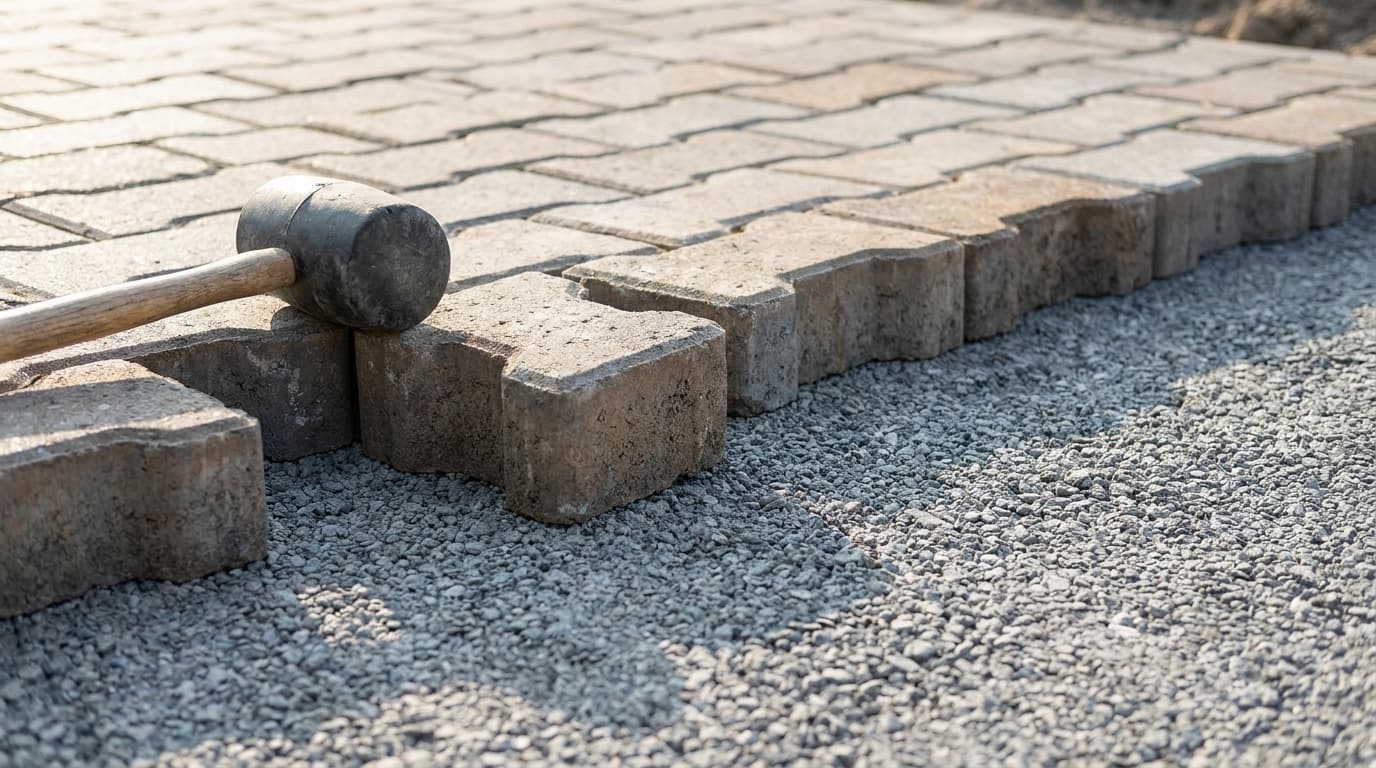
One of the most common questions we get from Charlotte homeowners planning a driveway is whether they actually need thicker pavers, or whether that's just an upsell. It's a fair question, because the difference between 60mm and 80mm pavers isn't visible once they're installed — you can't tell by looking. But the thickness genuinely changes what the surface can safely carry, and using the wrong one in the wrong place is one of the more expensive mistakes to fix after the fact. Here's what the numbers actually mean and how to decide.
What 60mm and 80mm actually mean
The number refers to the paver's thickness in millimeters — 60mm is roughly 2.4 inches, 80mm is roughly 3.1 inches. It sounds like a small difference, but that extra 20mm significantly increases the paver's ability to resist cracking and shifting under concentrated point loads, like a tire rolling and turning across the same small area repeatedly. Thickness isn't the only factor in a paver's strength — the base underneath matters just as much — but it's the baseline rating manufacturers use to classify what a paver is rated for.
Load ratings: foot traffic vs vehicle vs heavy vehicle
60mm pavers are rated for pedestrian and light foot-traffic use — patios, walkways, pool decks, and courtyards where the only load is people walking, furniture, and the occasional wheelbarrow. 80mm pavers are rated for vehicular traffic — standard passenger vehicle driveways, parking pads, and light commercial areas. For anything heavier, like a driveway that regularly sees an RV, box truck, or commercial equipment, some manufacturers offer a reinforced 80mm-plus or specialty product rated for heavy vehicle load, and base depth typically increases as well, often to 10-12 inches of compacted aggregate instead of the standard 6-8 inches under a normal driveway.
When a driveway truly needs 80mm
Any driveway carrying regular car or light truck traffic should be 80mm, full stop — this isn't really a judgment call. Passenger vehicles weigh 3,000-5,000 pounds, and the repeated turning and braking at the garage end of a driveway concentrates that weight on a small area of pavers over and over. A 60mm paver under that kind of repeated point load is significantly more likely to crack or settle unevenly within a few years, especially where a tire consistently turns in the same spot.
When 60mm is fine
Patios, walkways, courtyards, pool surrounds, and any area that will never see a vehicle are appropriately built with 60mm pavers. There's no functional benefit to using 80mm on a patio — it doesn't make the surface more durable for foot traffic, it just adds unnecessary material cost and weight for no real gain in performance where the load was never going to test the paver's strength in the first place.
The cost difference per square foot
80mm pavers typically cost $0.75-$1.50 more per square foot in material than the equivalent 60mm product in the same style and color line, and installation labor runs slightly higher too because the deeper base required for a vehicle-rated driveway means more excavation and more compacted aggregate. On an average driveway, that difference usually adds up to roughly $500-$1,200 more than an identically sized 60mm installation — a real but modest premium given what it protects against.
What changes underneath the pavers, not just on top
The base underneath a driveway matters as much as the paver thickness sitting on it. A standard 60mm patio typically sits on 4-6 inches of compacted aggregate base, while an 80mm driveway needs 6-8 inches minimum, sometimes more depending on soil conditions — and Charlotte's clay soil, which doesn't drain or compact as predictably as sandy soil, makes proper base depth even more important here than in some other regions. An 80mm paver installed over a base built for foot traffic will still underperform, because the paver and the base underneath it have to be matched to the same load rating together.
A real Charlotte scenario: driveway and patio thickness decision in Indian Trail
A homeowner in Indian Trail was replacing a cracked concrete driveway and adding a connected side patio in the same project, and initially assumed both areas should use the same paver for a seamless look. We explained the load difference, and they went with 80mm for the 480 sq ft driveway and 60mm for the 280 sq ft side patio in a matching color to keep the visual continuity while using the right product in each zone. Rough breakdown:
- Excavation and base prep, driveway (8 in. compacted base): $3,400
- Excavation and base prep, patio (5 in. compacted base): $1,600
- 80mm pavers, driveway: $6,700
- 60mm pavers, patio (matching color): $3,300
- Labor, edge restraint, polymeric sand, sealing: $4,000
- Total: ~$19,000
Using 80mm across the entire 760 sq ft area instead would have added roughly $700-$900 more without any real benefit on the patio side, since it never carries vehicle load.
Frequently Asked Questions
We don't recommend it. 60mm pavers aren't rated for regular vehicle load, and using them under a driveway significantly raises the risk of cracking or uneven settling within a few years, especially in high-turn areas like near a garage. The material savings usually aren't worth the risk of an early repair or replacement.
No. Patios, walkways, and other foot-traffic-only areas are appropriately built with 60mm pavers. 80mm doesn't add meaningful durability where the surface never carries vehicle weight, so it's typically an unnecessary added cost on a patio.
Expect roughly $0.75-$1.50 more per square foot in material cost, plus somewhat higher labor due to the deeper compacted base a vehicle-rated driveway requires. On an average driveway, the total difference usually lands around $500-$1,200 more than an equivalent 60mm installation.
Standard 80mm pavers are rated for passenger vehicles, but regular RV, box truck, or heavy equipment traffic usually calls for a reinforced product and a deeper base, often 10-12 inches of compacted aggregate instead of the standard 6-8 inches. We assess actual vehicle weight and frequency before recommending the right spec.
Planning something similar? See how we approach paver patio installation in Charlotte and the surrounding metro, or find your town in our service area.
Get a Free Estimate
If you're not sure whether your project needs 60mm or 80mm pavers, we'll walk the site and spec the right thickness and base depth for exactly what it needs to carry.
Get a Free Estimate
.jpg)