.jpg)
Pavers sinking settling problems almost always have a traceable cause, and the location of the low spot tells you most of the story. A dip near a downspout is a different failure than a sunken edge or a wavy driveway apron. This is the diagnostic walk-through we use on service calls across Charlotte, Huntersville, and Fort Mill — symptom, likely cause, and what the honest repair actually costs.
Start By Mapping the Low Spots
Before guessing, get data. Wait for rain, then walk out ten minutes after it stops and photograph every puddle. Water is the best level you own.
Then, on a dry day, lay a 6-foot straightedge or a long level across the suspect areas in two directions. Note anything more than about 1/4 inch of gap under the straightedge. Write it down with locations. You now have a settlement map, and it usually points at one culprit.
Symptom: A Dip Right Below a Downspout
This is the single most common call we get.
Likely cause: Concentrated water discharge. A single downspout on a Charlotte roof can dump hundreds of gallons during one August thunderstorm. That water hits one spot, saturates the base, washes out fines, and softens the clay subgrade beneath.
What is happening underneath: The base has eroded into a shallow bowl. The pavers simply follow it down.
Fix: Lift the affected area, rebuild the base, and — critically — reroute the water. Extending the downspout underground 10 to 20 feet away with solid pipe to a pop-up emitter costs roughly $400 to $1,200. Repairing the pavers without fixing the downspout guarantees a repeat visit.
Symptom: The Outer Edge Is Dropping
Perimeter pavers tilting outward, joints opening along the border, the field slowly creeping.
Likely cause: Failed or missing edge restraint. Pavers are a flexible system. Without a rigid perimeter holding them, they spread. The spread shows up as edge drop and open joints.
Common versions of this failure:
- No edge restraint installed at all — just soil packed against the border
- Restraint spiked into the bedding sand instead of into compacted base
- Spikes at 24 inches or wider instead of 10 to 12 inches on center
- Base not extended past the paver edge (it should run 6 to 12 inches beyond)
Fix: Remove the perimeter course, extend and recompact base if needed, install proper polymer or aluminum restraint with 10-inch spike spacing, reset. Typically $18 to $35 per linear foot.
Symptom: A Wavy Driveway Apron
The first 8 to 12 feet of driveway — where it meets the street or garage — develops rolling humps and dips.
Likely cause: Insufficient base depth for vehicle loads, or uncompacted trench backfill. Aprons take the worst of it: turning wheels, delivery trucks, and often a utility trench that was backfilled with loose soil and never properly compacted.
What we look for: Wave spacing. Regular waves every few feet usually means base failure. A single sharp dip in a straight line across the drive is almost always a buried utility trench.
Fix: This one is rarely a small repair. Apron rebuilds usually mean full removal, excavation to 12 inches or more, and a proper reversible-plate-compacted base. Expect $18 to $32 per square foot for tear-out and rebuild in the Charlotte area.
Symptom: Joint Sand Keeps Disappearing
You sweep sand in, it looks great, and it is gone by the next season.
Likely cause: Water moving through the joints faster than the sand can resist — usually from poor surface slope, a roof valley dumping on one area, or original installation with plain masonry sand instead of a stabilized product.
Joint sand loss is not cosmetic. Sand transfers load between pavers. Once joints empty out, individual units rock, edges chip, and settlement accelerates.
Fix: Clean joints to about 1 inch deep, then refill with polymeric sand and activate per the manufacturer's directions. Typically $1.50 to $3.50 per square foot. If the joints empty again within a year, the problem is drainage, not sand.
Symptom: Birdbath Puddles in the Middle of the Field
Isolated dish-shaped puddles, usually 1/4 to 3/4 inch deep, sitting for hours after rain.
Likely cause: Localized base compaction failure. Often the base was compacted in one thick lift, so the lower portion was never truly consolidated. It settles unevenly over the first two or three seasons.
Sometimes the cause is simpler: an old tree stump, a filled-in fire pit, or construction debris buried in the yard before the house was landscaped. We found a partially buried section of concrete under a patio in Plaza Midwood two years ago — the homeowner had no idea it was there.
Fix: Spot lift-and-relay. Pull the pavers in the affected zone plus about 2 feet of margin, dig out and replace bad base, recompact in 3 to 4 inch lifts, reset. Usually $12 to $22 per square foot for the affected area, with most spot repairs landing between $600 and $2,500.
Diagnose Your Own Patio: A Checklist
Run through this before you call anyone. It will make the conversation far more productive.
- Does water pool anywhere within 10 feet of your foundation? (Priority issue — address first.)
- Are low spots near downspouts, or spread randomly?
- Do perimeter pavers tilt outward or sit lower than the field?
- Can you rock any individual paver with your foot?
- Are joints empty to a depth of more than 1/2 inch?
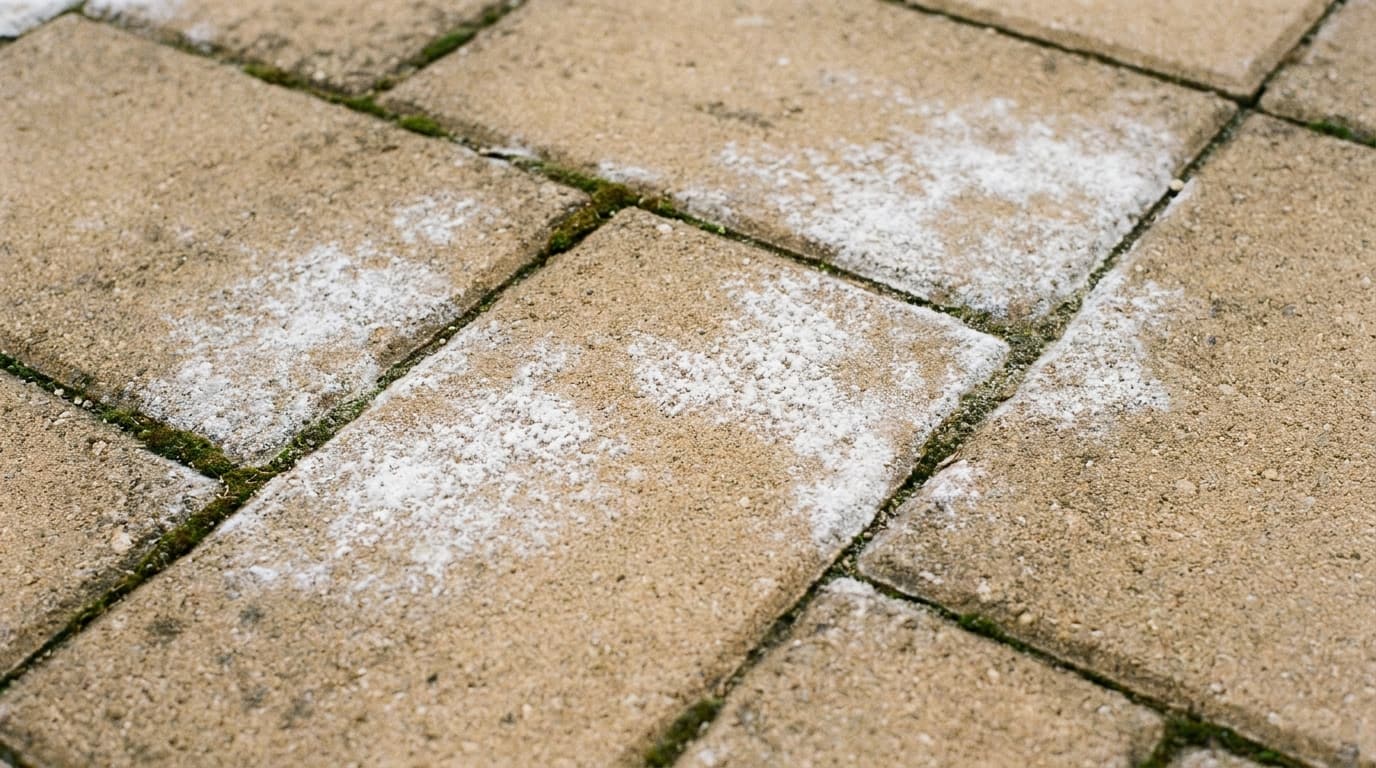
- Is there visible white haze (efflorescence) concentrated in low areas?
- How old is the installation? Settlement in years 1–2 usually means base error. Year 8+ often means normal wear plus drainage drift.
- Has anything changed above it — new roof, new gutters, a regraded neighbor's yard, a removed tree?
Question 8 catches more problems than people expect. A patio in Cornelius that had been flat for six years started settling after the homeowner removed two large water-hungry oaks. The soil moisture regime changed, and the clay responded.
Spot Repair vs. Full Tear-Out: How We Decide
We would rather do the smaller job when the smaller job will hold. Here is the honest threshold we use.
Spot lift-and-relay makes sense when:
- Under roughly 25% of the surface is affected
- The rest of the field is flat and tight
- The base under the good areas measures adequate depth on a probe test
- The cause is external and fixable (downspout, edge restraint, a single soft pocket)
Full tear-out and rebuild makes sense when:
- Settlement appears in multiple unrelated areas
- Base probe shows under 4 inches of stone on a patio, or under 6 on a driveway
- There is no geotextile fabric and the base is visibly clay-contaminated
- The surface has no consistent slope and never did
A rebuild on a 400 square foot patio in Pineville runs roughly $7,000 to $13,000 depending on paver selection. Spot repairs on the same patio might be $1,200. We will always tell you which one we think you actually need, including when the answer is "leave it alone another season and watch it."
Frequently Asked Questions
Rarely. Settlement driven by water follows the same water path every storm, so the low spot deepens and collects more. Settlement from poor compaction can slow after three or four years, but by then the surface is uneven enough that you are fixing it anyway. Addressing pavers sinking settling early costs less than waiting.
Adding bedding sand under a lifted paver is legitimate for tiny corrections — under about 1/2 inch. Beyond that you are filling a void that will keep growing. If the base beneath has washed out or the subgrade has softened, sand alone compresses and the dip returns within a season or two.
With a correctly built base on our clay — geotextile, 6 to 8 inches compacted in lifts, proper drainage — expect 20 to 30 years with only joint sand maintenance. Minor settlement of an eighth of an inch in the first year is normal as everything seats. Visible dips within two years indicate a base problem.
Almost not at all. Quality concrete pavers from major manufacturers all far exceed the strength needed. Settlement is a base and drainage issue, not a paver issue. Brand affects color retention, edge crispness, and texture — not whether your patio stays level.
Planning something similar? See how we approach paver patio installation in Charlotte and the surrounding metro, or find your town in our service area.
Get a Free Estimate
Send us photos of your low spots and we will tell you honestly whether this is a spot repair or a rebuild.
Get a Free Estimate