The single question that reshapes an outdoor kitchen budget more than any appliance choice is whether it gets a roof. We get asked constantly whether a cover is "worth it," and the honest answer depends on how the space gets used, what's already true about Charlotte's weather, and how long the homeowner plans to own the appliances. Here's how we walk clients through that decision on real jobs.
The real cost difference: roof or pergola vs open-air
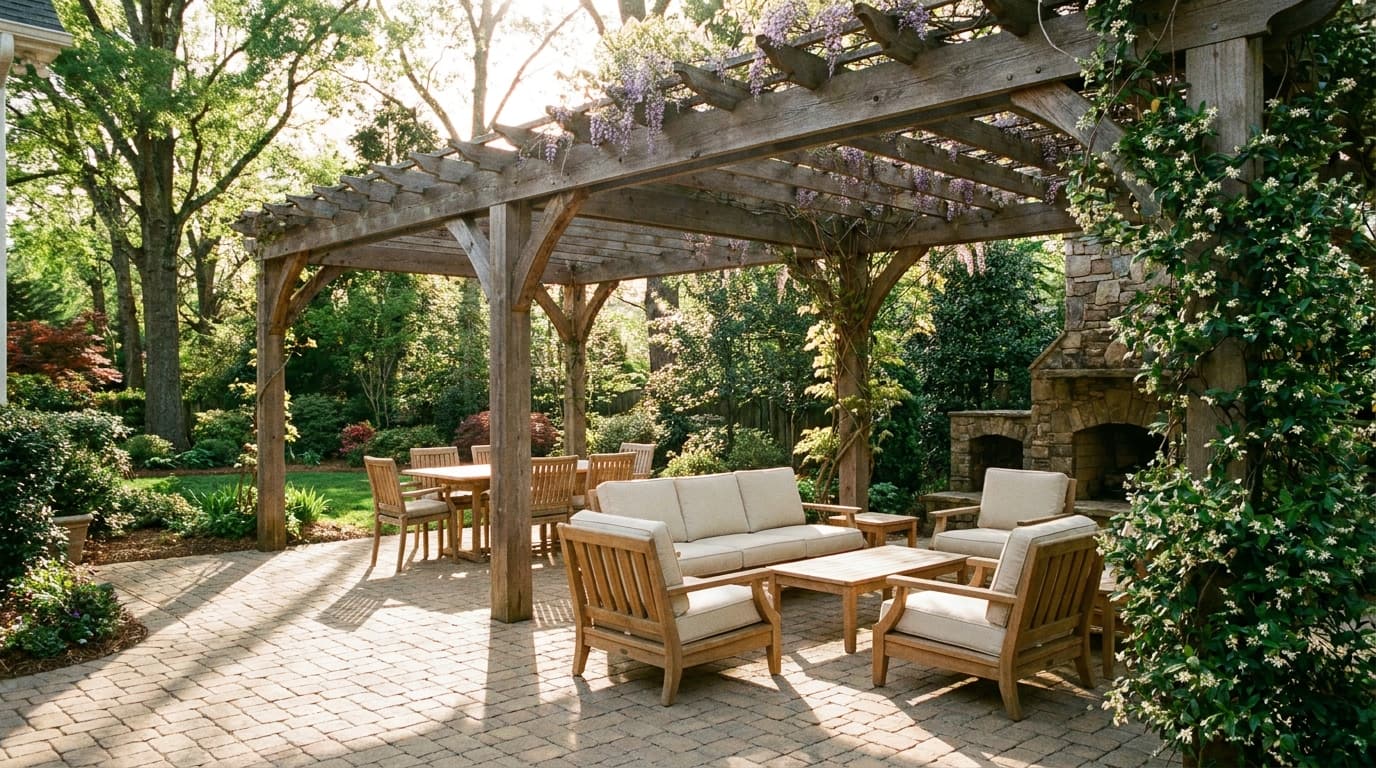
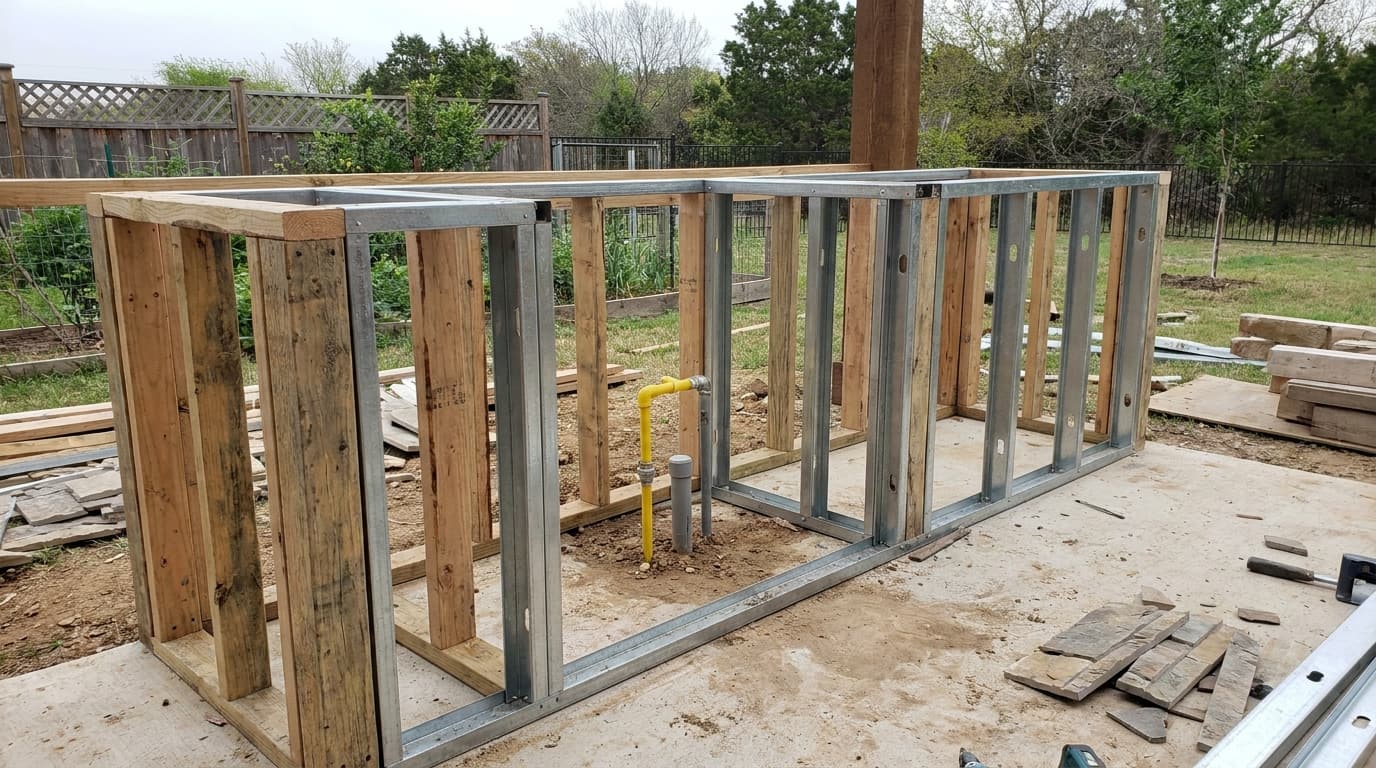
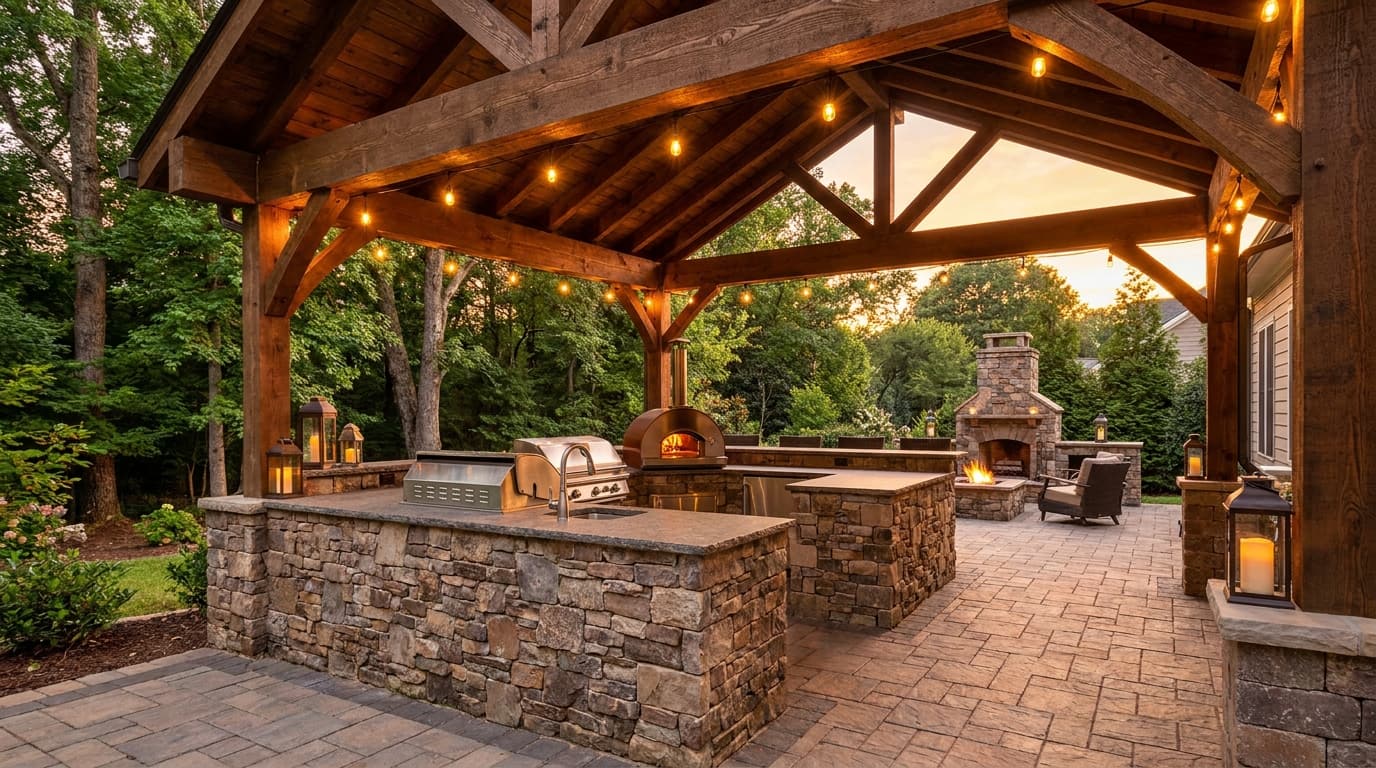
An open-air kitchen — grill island, counter, storage, no structure overhead — is the cheapest way to get a functional cooking space outside. Adding a cover changes the number meaningfully. A simple attached shed-style roof tied into the house typically adds $8,000-$16,000 depending on span and roofing material, while a freestanding wood or aluminum pergola over the same footprint runs $6,000-$14,000. A fully enclosed structure with a solid roof, ceiling fan, and lighting can add $18,000-$30,000+ on top of the kitchen itself. None of that is small money, which is exactly why we walk through the tradeoffs instead of defaulting to "always cover it."
A middle-ground option: partial shade structures
Not every kitchen needs a full roof to get most of the benefit. We build a fair number of partial-shade solutions — a shade sail over just the cooking zone, a small cantilevered awning off the house, or a pergola with only the section directly over the grill fitted with solid panels while the rest stays open for a dining area that still wants sun in the cooler months. These typically run $3,500-$8,000, well under a full roof or enclosed structure, and they solve the single biggest complaint — standing over a hot grill in direct sun — without committing to the cost of covering the entire patio.
How Charlotte summers change the calculus
Charlotte sees roughly 90+ days a year above 85°F, and July afternoons regularly hit the mid-90s with heat index numbers well above that. An uncovered kitchen in full sun by 2pm gets hot enough that stone counters and metal fixtures are genuinely uncomfortable to touch, and most people simply don't cook outside during the hottest stretch of the day regardless of how nice the kitchen looks. A cover with even partial shade drops the usable surface temperature enough that the kitchen stays in use through the hottest months instead of sitting idle from June through August.
What rain and humidity do to an unprotected kitchen
Charlotte averages around 43 inches of rain a year spread fairly evenly across the seasons, plus the humidity that comes with a Piedmont summer. An open-air kitchen isn't ruined by that, but it does mean more frequent covering and uncovering of grills, more staining risk on light-colored stone counters, and faster wear on cabinet doors and hardware that see direct rain. A cover doesn't eliminate humidity, but it stops direct rain exposure entirely, which is the bigger driver of long-term wear on an outdoor kitchen's finishes.
Appliance protection and longevity
Stainless grills, side burners, and outdoor-rated fridges are built to handle weather, but "weather resistant" isn't the same as "weatherproof." Direct sun breaks down control knobs and plastic components faster than shaded exposure, and standing water on a grill lid after rain accelerates rust at seams and hinges, even on 304-grade stainless. We regularly see uncovered grills need hood or knob replacement around year 4-5 that a covered equivalent doesn't need until year 8-10. On a $3,000-$6,000 grill, that's a real cost difference over the appliance's life, not a marketing point.
Resale value: what covered structures add
A covered outdoor kitchen reads to a buyer as a finished living space, not just equipment in a backyard, and that distinction matters at resale more than most single upgrades. Appraisers and buyers consistently respond better to a structure with a defined roofline than to the same appliances sitting in the open, because it signals a year-round usable space rather than a fair-weather feature. It's the single upgrade we see add the most perceived value relative to its cost.
How we help clients actually decide
We ask three questions on nearly every consultation, and the answers usually point clearly one direction. First, what time of day will this kitchen realistically get used — if it's mostly evening cookouts after the sun drops, heat matters less and an open-air kitchen may be plenty. Second, does the site face west or south, where afternoon sun is most direct and longest, versus north or east, where a covered structure matters less. Third, is this a five-year house or a forever house — appliance longevity and resale value both weigh more heavily when a family plans to stay long-term. None of these questions has a universally right answer, but walking through them with real numbers next to each option is what turns "should I cover it" into a decision a homeowner feels good about.
A real Charlotte scenario: covered kitchen build in Concord
A Concord homeowner had budgeted for a straightforward open-air grill island but asked us to price a covered version before committing. The kitchen itself — grill, side burner, storage, granite counter — priced at $19,400. Adding a freestanding cedar pergola with a polycarbonate rain-clear panel roof over the full footprint added $11,200, including footings poured alongside the patio base and two ceiling fans. Total: $30,600. They went with the covered version specifically because the space faces west and gets full afternoon sun, and after living with it through a full summer, they told us the fans made a bigger day-to-day difference than they expected going in.
Frequently Asked Questions
A pergola with slats or a shade cloth blocks 60-80% of direct sun depending on spacing, which is enough for most people; a solid roof blocks rain entirely and gives closer to full shade, so the choice usually comes down to whether rain protection matters as much as heat.
Yes, but it costs more done separately — footings poured after the patio and kitchen are finished often require cutting into existing pavers or working around the counter, which is why we always ask about a future cover before pouring any footings, even if the budget starts open-air.
Yes — a solid roof sheds a meaningful amount of water in a heavy storm, and that runoff needs to be directed off the patio surface rather than pooling at the kitchen's base, which we plan into the patio's grade and any gutter or downspout tie-in.
Yes, more than most people expect — moving air drops the perceived temperature several degrees and also helps keep smoke and grill heat from lingering over the cooking area, which is why we include at least one fan on nearly every covered kitchen we build, wired into the same electrical rough-in as the lighting.
Planning something similar? See how we approach paver patio installation in Charlotte and the surrounding metro, or find your town in our service area.
Get a Free Estimate
Tell us how you actually plan to use your outdoor kitchen and we'll price both the open-air and covered versions side by side.
Get a Free Estimate