Backyard drainage Charlotte NC problems come down to one fact: our red clay absorbs almost nothing, so every drop that lands has to be moved on the surface or piped somewhere. Choosing the wrong system wastes thousands. This guide compares the seven options we install most, what each costs, when it is the right call, and where each one genuinely falls short on clay.
First: Find Out Where the Water Actually Goes
Skip this and you will buy the wrong solution.
Go outside during a real rain — not after. Watch for 10 minutes. Note where sheet flow forms, where it enters your yard from a neighbor's property, where it leaves, and where it stops moving. Photograph it. Then come back an hour after the rain stops and mark everything still holding water with landscape flags.
Two things to measure while you are out there:
- Distance from any standing water to your foundation. Under 10 feet is urgent.
- Rough slope of the problem area. Drop a level on a 4-foot board. If the bubble sits nearly centered, you have close to zero fall, and gravity-based solutions get harder.
The Decision Tree
Work this top to bottom. Stop at the first match.
If water pools within 10 feet of the foundation → Start with downspout extensions and regrading. This is a structural risk, not a lawn inconvenience. Get the roof water piped away first, then re-evaluate. Roughly 40% of the "I need a French drain" calls we take in Charlotte are solved by downspouts alone.
If water sheets across the yard but never really stands → Surface regrading, possibly with a shallow swale. You have a path problem, not a volume problem.
If a specific low area holds water for more than 24 hours → French drain or catch basin with solid pipe, depending on whether the water is subsurface or surface.
If water runs off a patio or driveway toward the house → Channel drain at the low edge, tied into solid pipe.
If you have nowhere downhill to discharge → Dry well, or a permeable paver zone with a stone reservoir. Both need honest expectations on clay.
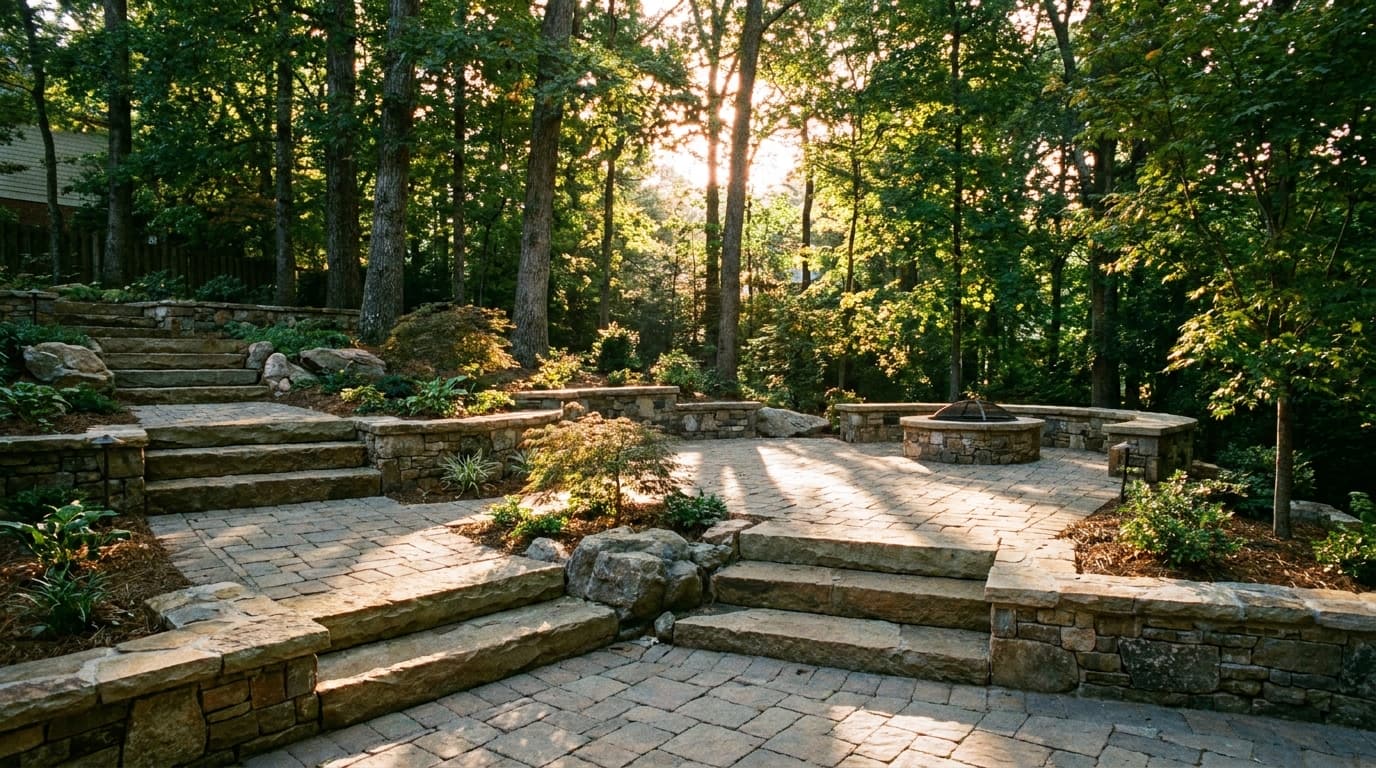
If your lot is steeply sloped (common in Belmont, Mount Holly, parts of Huntersville) → Interception drainage uphill of the improvement, often combined with a retaining wall and terracing.
Option 1: Downspout Extensions
How it works: Solid 4-inch PVC or corrugated pipe carries roof water from the downspout to a pop-up emitter or daylight discharge 10 to 30 feet from the house.
When it is right: Almost always, and almost always first. A 2,000 square foot roof sheds roughly 1,200 gallons per inch of rain. Concentrating that at four corners of your foundation is the root of a lot of Charlotte yard problems.
Cost: $300 to $1,200 per run installed, depending on length and whether it crosses hardscape.
Limitation on clay: Pop-up emitters need somewhere for water to go once it surfaces. On flat clay lots, the emitter can become its own soggy spot. It needs real fall to work.
Option 2: Surface Regrading
How it works: Reshape soil so water runs where you want it. Minimum 1% slope away from the house; 2% is better on clay.
When it is right: Negative grade against the foundation, or a yard with no defined drainage path. This is the least glamorous fix and often the most effective.
Cost: $1,500 to $6,000 for a typical backyard section, more if significant fill and sod are involved.
Limitation on clay: Freshly placed clay fill settles. Expect some touch-up in year one, and expect grass to struggle until topsoil is amended. Regrading also does nothing for water arriving from a neighbor's property uphill.
Option 3: French Drains
How it works: A trench, typically 12 to 24 inches deep, lined with geotextile fabric, containing perforated pipe surrounded by clean No. 57 stone, wrapped and backfilled. It collects subsurface and near-surface water and carries it to an outlet.
When it is right: Persistent saturation in a defined area, a chronic wet strip along a slope, or interception uphill of a patio or foundation.
Cost: $45 to $95 per linear foot installed in the Charlotte area, depending on depth, access, and outlet distance. A typical 60-foot run lands around $3,000 to $5,500.
Limitation on clay — read this part: A French drain in clay only captures water that reaches it. Clay does not move water laterally through the soil the way sand does. In heavy clay, a French drain's effective capture width can be quite narrow — sometimes just a few feet on either side. That is why French drains in Charlotte often disappoint. They work well as interception along a slope and poorly as a general "dry out my whole yard" tool. Placement matters more than length.
The outlet is also non-negotiable. A French drain with no daylight discharge is a buried bathtub.
Option 4: Channel / Trench Drains
How it works: A linear grated channel set flush into hardscape, catching surface water at the low edge of a patio, driveway, or garage apron, and feeding solid pipe.
When it is right: Anywhere a paved surface drains toward the house or toward a door. Garage aprons on sloped Charlotte lots are a classic case.
Cost: $70 to $160 per linear foot installed, higher if concrete encasement is required for vehicle loads.
Limitation: Grates collect leaves. In Myers Park or Dilworth with heavy tree canopy, plan on clearing them seasonally. A clogged channel drain sends water exactly where you did not want it.
Option 5: Catch Basins + Solid Pipe
How it works: Grated boxes at low points collect surface water and feed 4-inch solid (not perforated) pipe running to a discharge point. The pipe is solid on purpose — you want the water gone, not seeping into clay along the way.
When it is right: Defined puddles, low spots at the bottom of a slope, and collecting multiple downspouts into one system. This is our most common backyard drainage Charlotte NC solution because it is honest about what clay can do — move surface water, do not pretend the soil will absorb it.
Cost: $350 to $700 per basin, plus $25 to $50 per linear foot of pipe. A three-basin system with 100 feet of pipe often lands between $4,000 and $7,500.
Limitation: Requires fall to a discharge point. Basins need a sump below the outlet and occasional cleanout. And you need somewhere legal to discharge — check with Mecklenburg County or your municipality before running pipe toward a property line.
Option 6: Dry Wells
How it works: A buried stone-filled or chambered reservoir that holds water and lets it infiltrate over time.
When it is right: Moderate water volume with no available downhill outlet.
Cost: $1,500 to $4,500 for a residential unit.
Limitation on clay — be realistic: A dry well works only as fast as the surrounding soil accepts water. Charlotte clay often infiltrates at well under 0.5 inches per hour. A dry well sized for sandy soil will simply fill and stay full here. When we do install them on clay, we oversize the storage volume substantially and treat the well as detention that buys time between storms, not as disposal. Always do a percolation test first. Always.
Option 7: Permeable Paver Zones
How it works: Pavers with enlarged joints filled with small clean stone, over an open-graded stone reservoir. Water passes through the surface into storage below.
When it is right: New or replacement patios and driveways where you want the hardscape itself to stop contributing runoff. Also useful where impervious area limits are a concern — check with Mecklenburg County on stormwater requirements for your parcel.
Cost: Typically $5 to $12 per square foot above a standard paver install, driven by the deeper reservoir base.
Limitation on clay: Same as the dry well. Without infiltration, the reservoir needs an underdrain to daylight. We design most Charlotte permeable installs that way — the stone base becomes a detention layer that meters water out slowly instead of dumping it all at once. That is still a real benefit, but it is not the "water just disappears" story sometimes advertised.
A Real Charlotte Example
A Matthews homeowner called us about a backyard that stayed muddy from November through April. Two previous contractors had quoted French drains — one at 140 feet, around $9,000.
We watched it during a storm. The water was not coming up from below. It was sheeting off a 1,100 square foot roof section with two downspouts discharging four feet from the foundation, then pooling in a flat spot with a slight negative grade back toward the house.
The fix was two piped downspout runs to a pop-up emitter, one catch basin in the low spot, about 70 feet of solid pipe to daylight at the rear property line, and regrading a 25-foot strip along the foundation. Total was a bit over $5,000. Two full winters later it is dry.
The lesson is not that French drains are bad. It is that diagnosis comes before hardware.
Frequently Asked Questions
They work when placed correctly and given a real outlet, particularly for intercepting water on a slope before it reaches a patio or foundation. They disappoint when installed as a general yard-drying measure, because clay does not feed water sideways into the trench efficiently. Position and discharge matter far more than total trench length.
Yes. We routinely cut in channel drains along a patio edge, add catch basins in adjacent low areas, or lift and reset a section to correct slope. Retrofitting typically costs $1,500 to $6,000 depending on scope. It is meaningfully cheaper than rebuilding a patio damaged by years of standing water.
Generally to daylight on your own property, away from structures, and not concentrated onto a neighbor's lot. Rules vary by municipality across Charlotte, Pineville, Huntersville, and Fort Mill. Check with Mecklenburg County or your local jurisdiction before running pipe near a property line.
Most residential systems take 2 to 5 working days. Downspout extensions alone can be one day. Larger regrades with sod restoration run longer, and we schedule around wet weather since working saturated clay creates more problems than it solves.
Before, or at the same time. Drainage design should drive patio elevations and slope, not the reverse. Doing them together also avoids paying twice for excavation and access, which usually saves 10% to 20% compared to two separate projects.
Planning something similar? See how we approach paver patio installation in Charlotte and the surrounding metro, or find your town in our service area.
Get a Free Estimate
Show us where the water sits and we will tell you which of these actually solves it — including when the cheap fix is the right one.
Get a Free Estimate