.jpg)
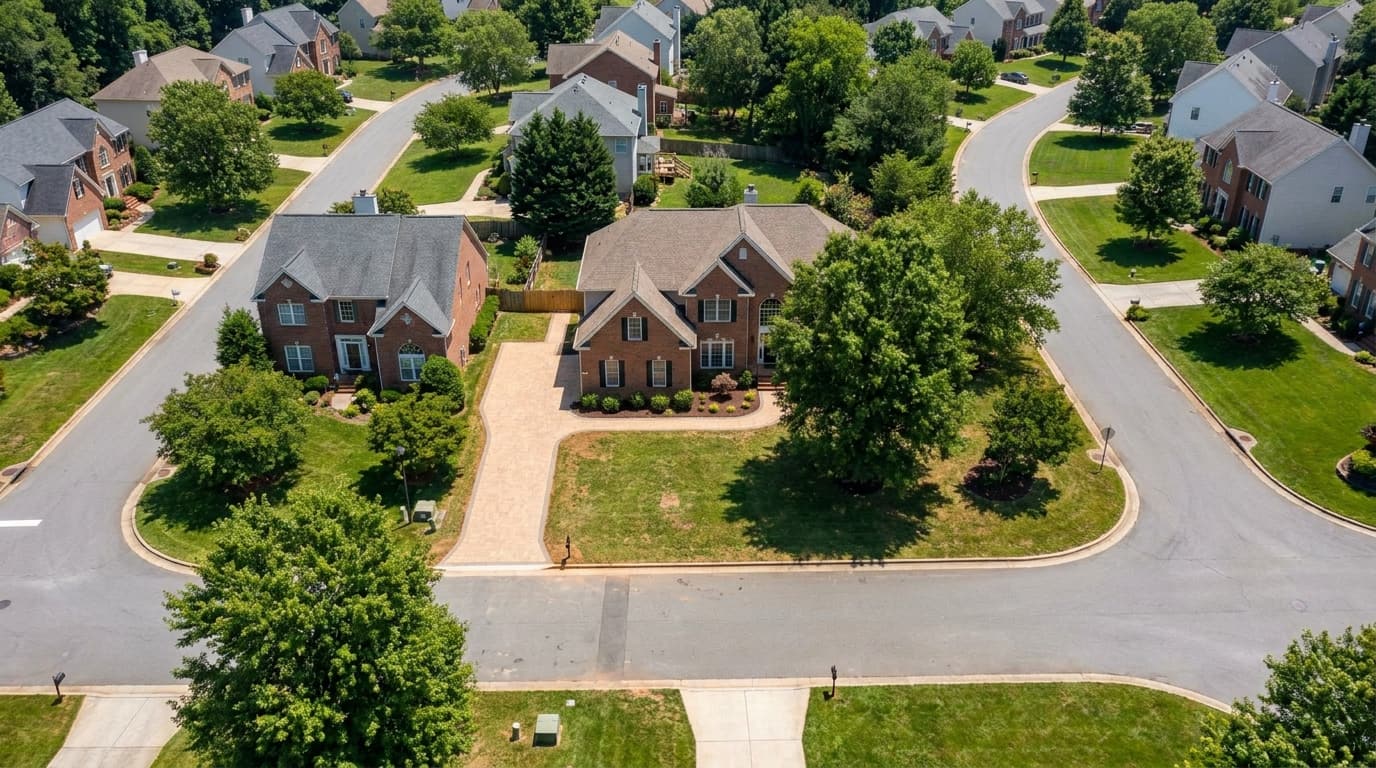
Impervious surface limits in Charlotte decide how much hardscape your lot is legally allowed to hold — and most homeowners find out about the cap after they have already designed the patio. Every square foot of roof, driveway, walkway, patio, and slab counts against a percentage of your lot area. Here is what counts, why watershed lots are stricter, and how the math actually runs on a real property.
What "impervious" means
An impervious surface is anything that stops rain from soaking into the ground. Water hits it, runs off, and heads for a storm drain or a creek.
The regulatory concern is volume and speed. More impervious area means more runoff arriving faster, which means downstream flooding, stream bank erosion, and pollutants washing into the Catawba system. North Carolina often uses the term built-upon area for the same idea.
That is why the cap exists. It is not aesthetic. It is hydrology.
What counts against your total
Generally included:
- Roof area, measured at the drip line, including garage and covered porch
- Driveway and parking pads, concrete or asphalt
- Sidewalks and walkways
- Patios and slabs
- Pool decks and the pool shell surface
- Sheds and outbuildings with solid roofs
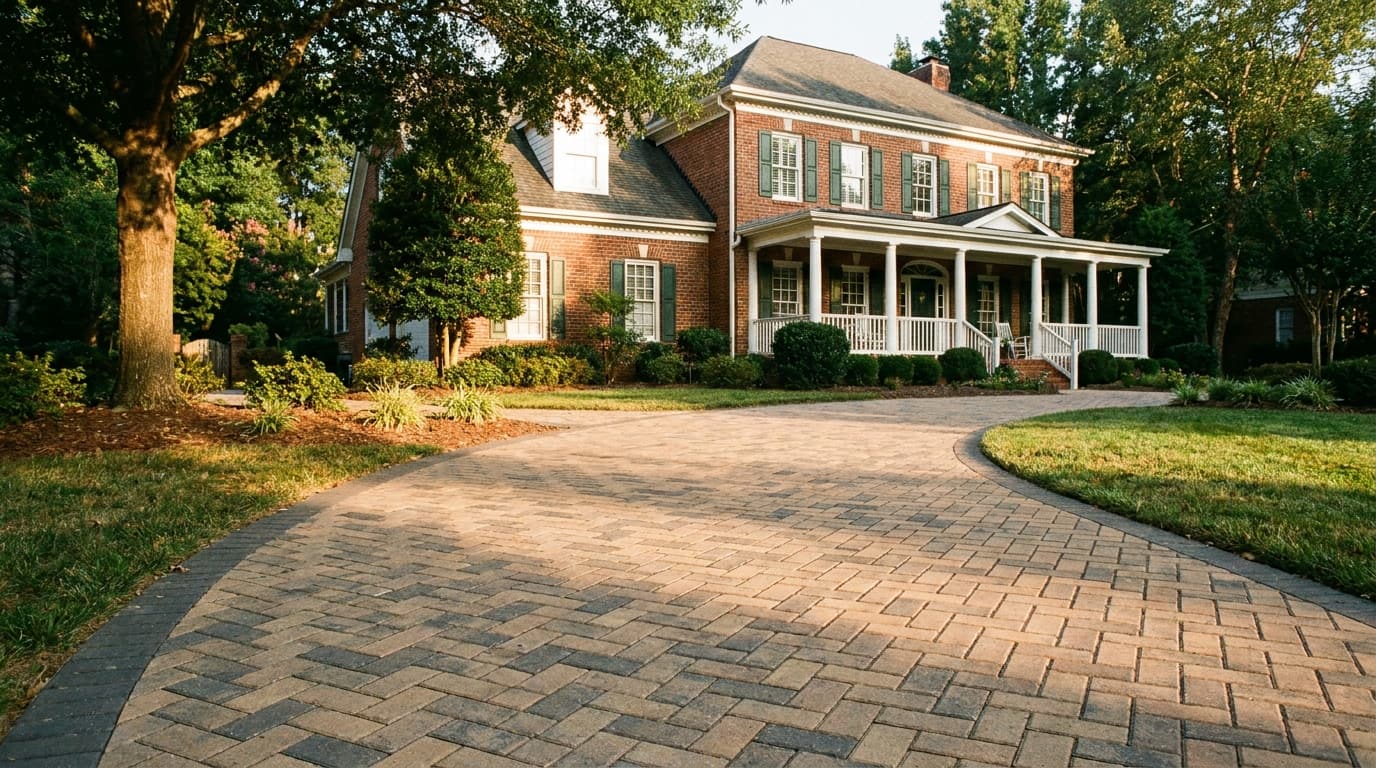
- Standard paver installations set on a conventional base
Often treated differently, but always verify:
- Permeable pavers with an open-graded aggregate reservoir, which may receive partial or full credit
- Gravel, which is treated inconsistently depending on jurisdiction and base construction
- Wood decks with gaps over pervious ground
Never assume a credit applies. Charlotte-Mecklenburg Storm Water Services is the authority on how a specific surface will be counted.
Zoning caps and watershed overlays stack
Two separate layers can limit you.
Your zoning district sets a base coverage limit. Denser districts allow higher percentages; large-lot residential districts allow less.
Your watershed overlay can override that with something stricter. Lots draining to protected water supply areas near Lake Norman, Lake Wylie, and Mountain Island Lake face tighter caps, because those are drinking water sources. Properties in parts of Huntersville, Cornelius, and Davidson commonly sit inside these overlays.
The stricter number governs. Find out which overlay you are in before you design, not after.
The worked example
Take a 12,000 sq ft lot in an established Charlotte neighborhood. Assume for this exercise a 30% coverage cap [VERIFY — your actual cap depends on district and overlay].
Total allowable impervious area:
12,000 × 0.30 = 3,600 sq ft
Now inventory what already exists:
| Surface | Area |
|---|---|
| Roof (drip line) | 2,100 sq ft |
| Concrete driveway | 900 sq ft |
| Front walk and stoop | 180 sq ft |
| Rear stoop and AC pad | 70 sq ft |
| Existing total | 3,250 sq ft |
Remaining allowance:
3,600 − 3,250 = 350 sq ft
That is the whole story on many Charlotte lots. The homeowner wanted a 600 sq ft patio. The lot has room for 350.
How permeable pavers change the math
Here is where the design gets interesting. If the jurisdiction grants credit for a properly built permeable system — open-graded base, no fines, adequate reservoir depth, and appropriate subgrade infiltration — some or all of that area may not count as impervious.
Say the same homeowner builds 350 sq ft conventionally and the remaining 250 sq ft as permeable pavers. If the permeable section receives full credit, the impervious total stays at 3,600 sq ft and the patio reaches the size he wanted.
If it receives a 50% credit instead, the permeable section adds 125 sq ft and puts him over. Same design, different outcome, entirely dependent on how the credit is applied.
This is exactly why we ask homeowners to confirm the credit with Charlotte-Mecklenburg Storm Water Services *before* we finalize the design. We can build it either way. We cannot decide how it gets counted.
What a real permeable system requires
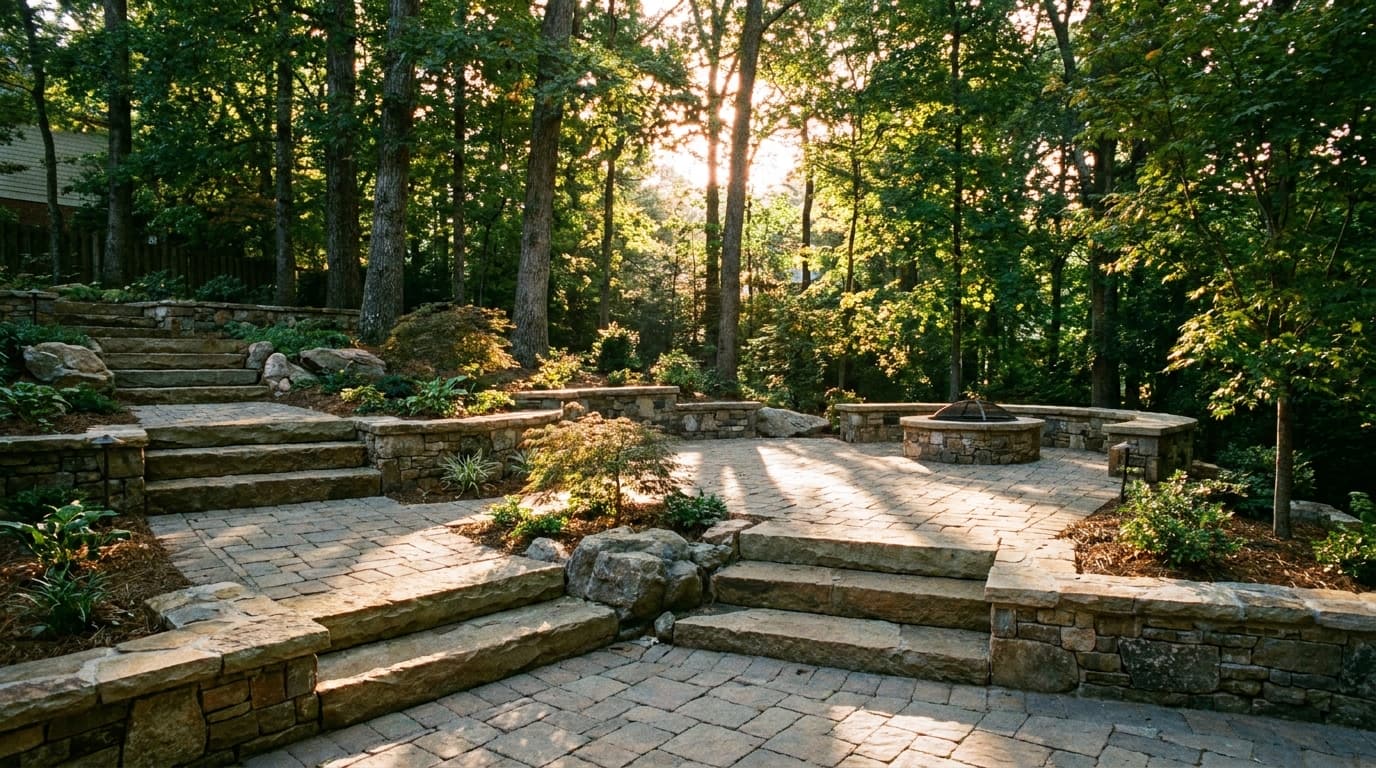
Permeable pavers are not regular pavers with wider joints. The whole assembly is different:
- Open-graded base — clean, washed stone with no fines, so water moves through it
- Reservoir depth sized to the design storm and the soil below
- Joint aggregate of small clean chip, not polymeric sand
- Geotextile at the subgrade where soils warrant it
- Subgrade that actually drains — Piedmont red clay infiltrates slowly, which sometimes requires an underdrain
- Maintenance — vacuum sweeping to keep joints from clogging over time
Charlotte clay is the real constraint. On a Matthews job we ran an infiltration check and found the subgrade drained far too slowly for a pure infiltration design. We built the reservoir with an underdrain tied to daylight instead. It worked, and it changed the cost.
Mitigation and credits, honestly stated
Some jurisdictions and watershed programs allow mitigation when a project exceeds a cap — engineered stormwater controls, rain gardens, detention, or offsite measures. Others simply do not permit the exceedance.
Mitigation generally costs more than redesigning. Before you chase a credit, price the smaller patio. Sometimes 350 sq ft laid out well beats 600 sq ft you had to buy your way into.
Where to verify your numbers
Do not take a contractor's word for your cap, including ours. The sources that actually decide:
- Charlotte-Mecklenburg Storm Water Services — watershed overlays, built-upon area, credits, buffers
- City of Charlotte Planning Department — zoning district and coverage limits inside city limits
- Mecklenburg County Code Enforcement — permits and inspections
- Your town office — Matthews, Mint Hill, Huntersville, Pineville, Cornelius, and Davidson administer their own rules
- Your recorded plat, deed restrictions, and HOA covenants — private limits that can be stricter than any of the above
Three ways homeowners find extra allowable coverage
When the math comes up short, the answer is rarely "shrink the patio." It is usually a redesign. Three moves recover the most square footage:
- Remove what you no longer use. Old concrete walks, an unused parking pad, or a crumbling slab behind the garage often account for 200–500 sq ft of coverage that is doing nothing. Demolition and haul-off usually runs $4–$8 per sq ft and buys back that area directly.
- Convert a portion to permeable. Rebuilding a 600 sq ft driveway apron as a permeable section can shift a meaningful share of that area off your impervious total, if the design meets local standards.
- Use spaced pavers with planted joints. Open-joint stepping paths and gravel-set stone read differently than a solid slab under many local standards.
Get all three priced before you cut the patio down. A homeowner in Mint Hill recovered enough coverage by demolishing an unused side pad to build the full patio she wanted.
Frequently Asked Questions
Conventional paver installations on a compacted dense-graded base are generally counted as impervious. Permeable paver systems built with open-graded aggregate may receive partial or full credit depending on the jurisdiction and design. Confirm treatment with Charlotte-Mecklenburg Storm Water Services before you finalize the size.
Start with your zoning district and check whether your property sits in a watershed overlay. Charlotte-Mecklenburg Storm Water Services and the City of Charlotte Planning Department can identify both. Suburban addresses should call their own town office, since Huntersville, Cornelius, and Davidson administer their own limits.
When they let you build the size you actually want on a constrained lot, yes. When you have plenty of allowance left, a conventional system costs less and needs less maintenance. The deciding factor is your remaining allowance and whether your jurisdiction grants the credit.
You may be denied a permit, required to remove hardscape, or required to install engineered stormwater controls. It also surfaces during resale. Running the math before design costs nothing and avoids all of it.
Planning something similar? See how we approach paver patio installation in Charlotte and the surrounding metro, or find your town in our service area.
Get a Free Estimate
Send us your lot size and a photo of your driveway and roof, and we will help you run the coverage math before you commit to a patio size.
Get a Free Estimate