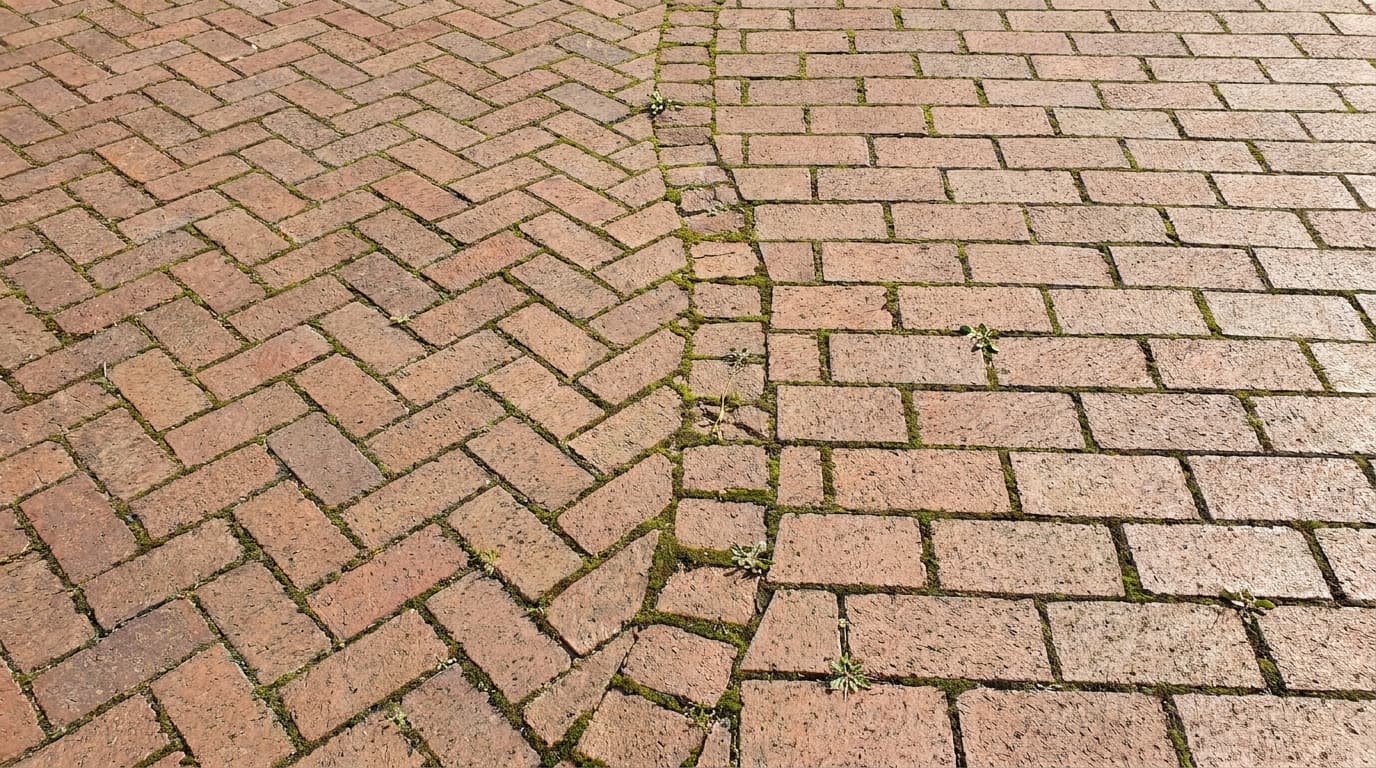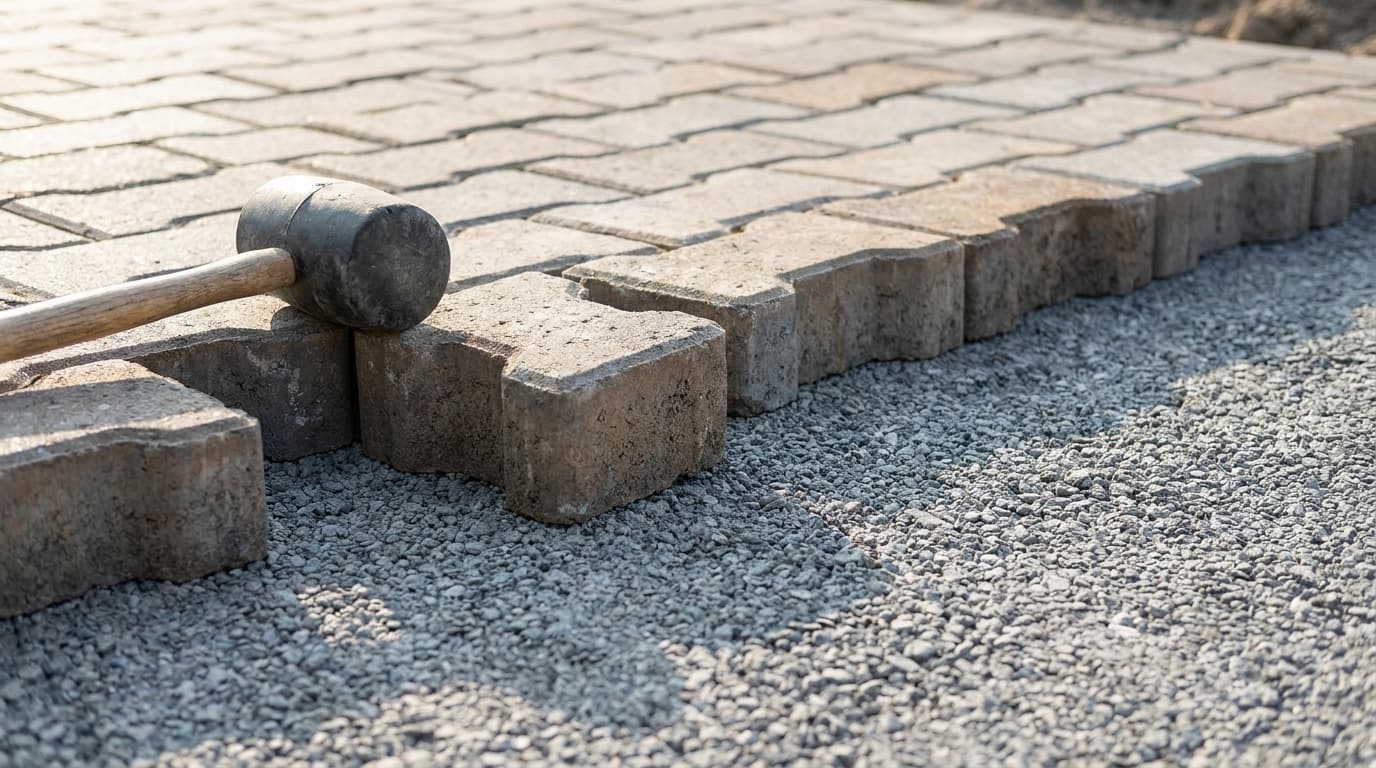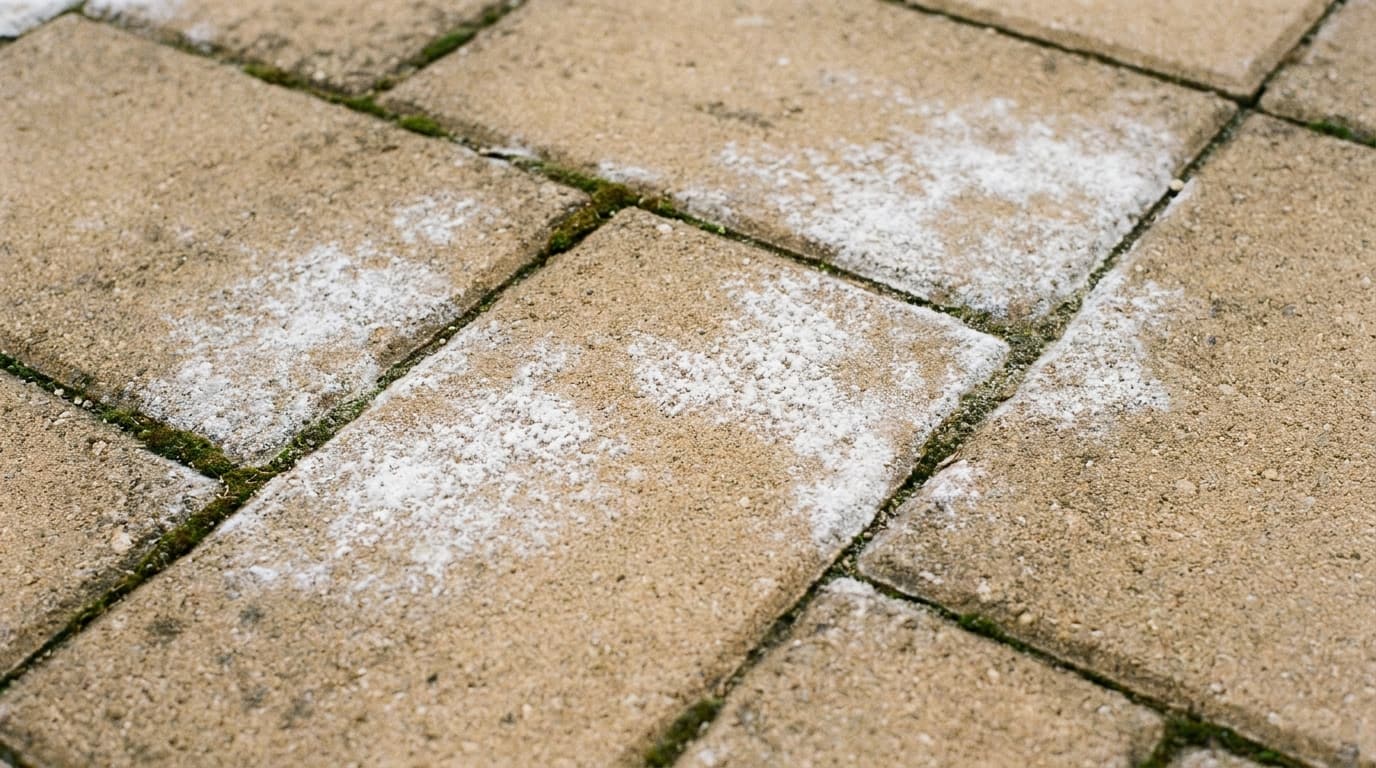
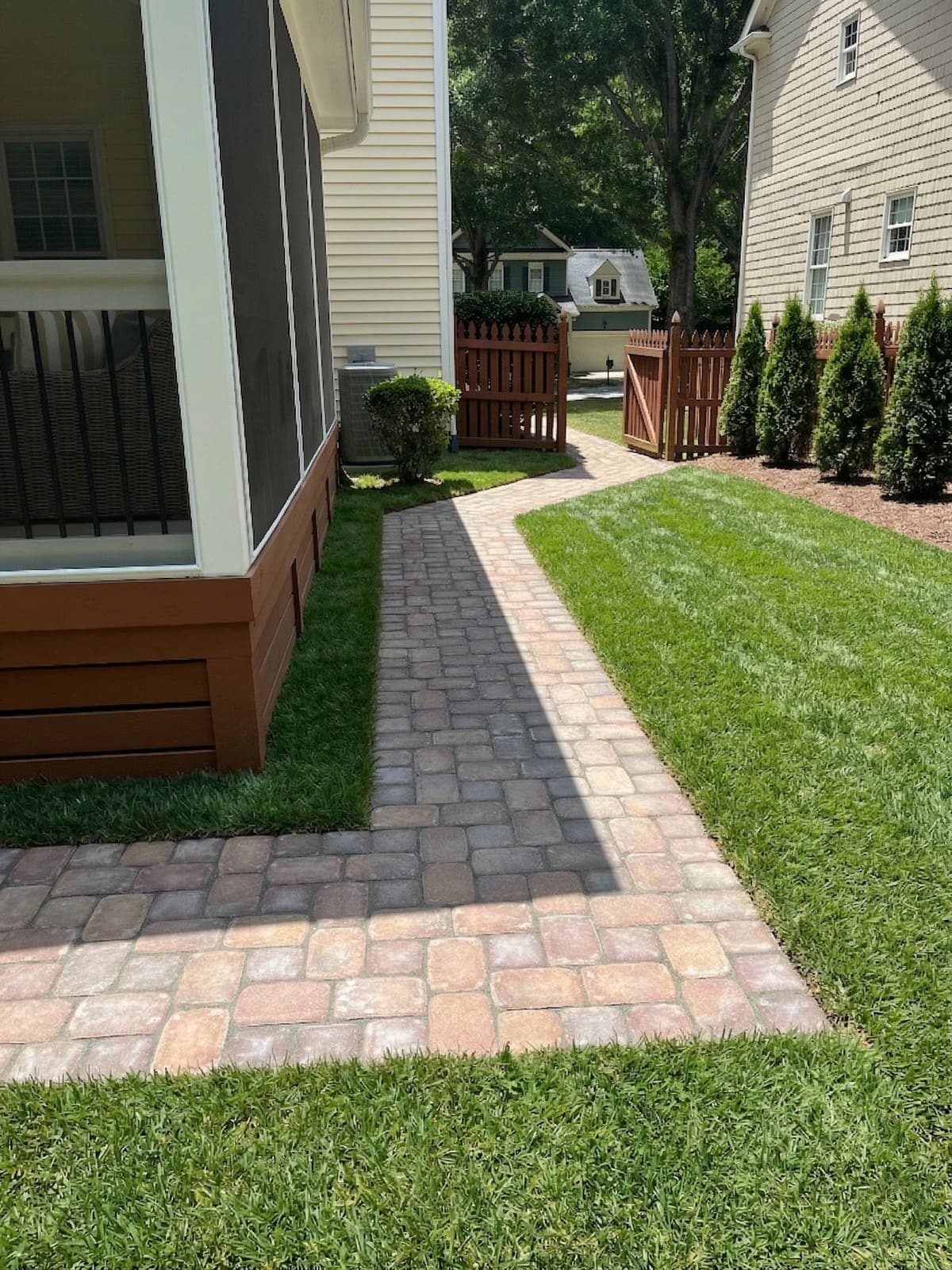
Permeable pavers in Charlotte handle water by letting it fall straight through the joints into a stone reservoir under the surface, instead of shedding it to a drain. That single difference changes the entire build below your feet. The base is not the compacted, fine-packed material under a standard patio. It is clean, washed, open stone with air space in it. Understanding that system tells you whether permeable makes sense on your lot.
The System Underneath Is the Product
A standard paver patio sits on dense-graded aggregate, often called crusher run or ABC. That material is engineered with fines in it so it locks up tight under a plate compactor. Water is supposed to run off the top, not through.
Permeable is the opposite philosophy. Every layer is open-graded and washed, meaning the small particles have been screened out on purpose. The voids between stones stay open, and those voids are the storage tank.
A typical residential section looks like this, bottom to top:
- Subbase: ASTM No. 2 stone, usually 6 to 12 inches deep depending on how much water the reservoir has to hold and how bad the soil is
- Base: ASTM No. 57 stone, roughly 4 inches, which bridges the coarse No. 2 below
- Bedding: ASTM No. 8 stone, a consistent 2 inches, screeded flat and never thicker
- Joints: the same No. 8 (sometimes No. 9) swept into joints typically 1/4 to 3/8 inch wide
No sand. No fines. No stone dust. If a crew screeds permeable pavers on concrete sand or sweeps polymeric sand into the joints, the system is dead on day one. Those materials plug the flow path.
Infiltration Rates Sound Better Than They Are
A brand-new permeable surface can pass water at rates most people find hard to believe — hundreds of inches per hour through the joints in lab conditions. Real-world surfaces clog with pollen, mulch, grass clippings, and Carolina red dust. Field rates drop steeply in the first few years and then stabilize if the surface is maintained.
That top-side number rarely limits the design anyway. The limiting factor is almost always what sits at the bottom of the reservoir. Which brings us to the part local homeowners need to hear.
The Charlotte Red Clay Problem
Charlotte sits on Piedmont clay. Dig two feet down in Matthews, Mint Hill, or Waxhaw and you hit dense red-orange clay that holds water like a bowl. Infiltration rates in that soil are often well under 0.5 inch per hour, and on compacted lots it can be near zero.
Full infiltration assumes the reservoir empties into the ground within a day or two. On tight clay it does not. Water sits in the stone, saturates the bedding, and in a January freeze that saturated layer moves.
We opened a failing permeable driveway off Providence Road where the previous crew built a beautiful No. 57 reservoir directly on undisturbed clay with no outlet. After heavy August thunderstorms the stone stayed wet for a week. Two winters of freeze-thaw and the surface had visible undulation across the wheel tracks.
The fix on most Charlotte lots is a perforated underdrain at or near the bottom of the reservoir, wrapped in geotextile and daylighted to a legal outlet or tied into an approved system. The stone still detains and filters water. It just does not depend on clay to swallow it. That is partial infiltration, and it is the honest default here.
What Permeable Pavers Cost in Charlotte
Expect permeable to run 20 to 40 percent more than a comparable standard paver installation. The premium comes from deeper excavation, more washed stone hauled in, more spoil hauled out, the underdrain, geotextile, and slower joint filling.
As rough planning numbers for the Charlotte market:
- Standard paver patio: $18 to $30 per square foot installed
- Permeable paver patio or walkway: $24 to $40 per square foot
- Standard paver driveway: $22 to $35 per square foot
- Permeable paver driveway: $28 to $48 per square foot
A 600 square foot permeable driveway in Dilworth therefore lands somewhere near $17,000 to $29,000 depending on excavation depth, access, and disposal. Tight side yards and mature root systems push the number up. Open access in a newer Huntersville or Indian Trail subdivision pushes it down.
Maintenance Is Non-Negotiable
The joints are a filter, and filters load up. Plan on vacuum sweeping every 1 to 2 years, more often under heavy tree cover in Myers Park or Plaza Midwood. A regenerative-air or vacuum sweeper pulls the top 1/2 to 1 inch of fouled joint stone, and clean No. 8 gets swept back in.
Between visits, keep it simple:
- Blow leaves and pollen off rather than letting them mat down
- Never top-dress with topsoil, sand, or mulch near the edges
- Keep grass clippings off the surface
- Do not pressure wash aggressively straight down into joints
- Skip winter sand; it is a clogging agent
Cost for professional vacuum service typically runs a few hundred dollars per visit for a residential driveway.
Lifespan and Honest Expectations
The pavers themselves are concrete units rated well over 8,000 PSI and will outlast most of us. The reservoir does not wear out either. What ages is the joint. Maintained properly, a permeable installation performs for 20 to 30 years or more. Neglected, it becomes a very expensive impermeable patio in under a decade — still attractive, just no longer functional as stormwater control.
When Permeable Is Worth It, and When It Is Not
Permeable pavers are worth serious consideration when:
- Your lot has runoff nuisance and no clean place to send it
- You are adding impervious area and bumping against a lot coverage limit
- You want to eliminate surface puddling on a flat backyard in Ballantyne or Fort Mill
- Your project is near a stream buffer or a sensitive drainage area
- A stormwater credit or reduced fee may apply — worth asking Charlotte-Mecklenburg Storm Water Services whether your specific project qualifies
Permeable is usually the wrong call when:
- The area collects heavy sediment, like the base of an unstabilized slope
- Vehicles will track mud onto it regularly
- Nobody will commit to the sweeping schedule
- The budget is already tight and the drainage problem has a simpler fix
- Groundwater or bedrock sits close to the surface, leaving no room for the reservoir
On a steeply sloped lot in Weddington we talked a homeowner out of permeable entirely. Runoff from the upslope pasture would have blinded the joints in two seasons. Standard pavers with a properly designed swale cost less and solved the actual problem.
Frequently Asked Questions
They work, but rarely as full infiltration systems. Piedmont red clay drains too slowly to empty a stone reservoir on its own. Most Charlotte installations use a perforated underdrain so the reservoir detains, filters, and slowly releases water to a legal outlet. Skipping that underdrain on clay is the single most common local failure we get called to repair.
No. Polymeric sand is designed to bind and seal joints, which is exactly what you do not want. It will plug the flow path and turn a permeable surface into a standard one. Permeable joints take clean, washed angular stone — typically ASTM No. 8 or No. 9 — swept in and refreshed during maintenance.
Yes, when built for vehicle loads. That means a deeper open-graded section, proper compaction of each lift, and a paver thickness suited to traffic. The interlock is mechanical, not adhesive, so edge restraint quality matters a great deal. We build residential permeable driveways heavier than patios as a rule.
It may. Mecklenburg County and the City of Charlotte have offered credits or adjustments for qualifying stormwater practices, but eligibility depends on design, documentation, and inspection. Check with Charlotte-Mecklenburg Storm Water Services before assuming a credit is available for your project. Never budget around a credit you have not confirmed.
Surface infiltration drops noticeably within the first two to three years, especially under heavy tree canopy. That is normal, not failure. Vacuum sweeping every one to two years restores most of the original rate. Left alone for a decade, the joints can seal enough that water sheets off the surface instead of passing through.
Planning something similar? See how we approach paver patio installation in Charlotte and the surrounding metro, or find your town in our service area.
Get a Free Estimate
If you are weighing permeable pavers for a Charlotte driveway or patio, we will dig a test hole, look at your actual soil, and tell you honestly whether the system will perform on your lot.
Get a Free Estimate