.jpg)
Paver base preparation determines roughly 90% of how long your patio stays flat, and it is entirely invisible once the job is done. That is exactly why it gets shortchanged. This is the actual install sequence we follow on Charlotte clay, layer by layer, in order — with the numbers, so you can hold any bid up against it.
Layer 0: Layout, Slope, and Excavation Depth
Nothing gets dug until the finished elevations are set. We stake the perimeter, pull string lines, and establish the finished paver height first, then work backward down through every layer.
Slope comes first because you cannot add it later. Minimum 1% fall away from the house — that is about 1/8 inch per foot. We prefer 1.5% to 2% on Charlotte clay because the ground barely absorbs anything and everything has to shed. On a 20-foot-deep patio, 2% means 4.8 inches of drop from house to outer edge. That is real, and it has to be planned.
Excavation depth is finished elevation minus paver thickness minus bedding minus base:
- Patio, 2 3/8-inch pavers: 2.375 + 1 + 7 = about 10.5 inches
- Driveway, 3 1/8-inch pavers: 3.125 + 1 + 10 = about 14 inches
- Pool deck, 2 3/8-inch pavers: 2.375 + 1 + 8 = about 11.5 inches
We over-excavate the footprint by 6 to 12 inches on all sides. The base has to extend past the paver edge so the perimeter has something to sit on and the edge restraint has something to bite into.
Layer 1: The Subgrade — Compact What You Are Building On
Once we hit design depth, the exposed clay gets compacted before anything else touches it. Usually 2 to 4 passes with a reversible plate, more on driveways.
Then we proof-roll. On a patio that can be as simple as walking a loaded wheelbarrow across it and watching. On a driveway we use a loaded truck or skid steer. Any area that visibly flexes gets undercut — dug out 12 to 18 inches deeper and backfilled with clean stone.
Moisture control is a real part of this. Clay compacts best near its optimum moisture content. Too dry and it will not knit. Too wet and it pumps — you will literally see water rise around the plate. When clay pumps, we stop and wait. In a Charlotte August that might mean 48 to 72 hours after a storm.
Layer 2: Geotextile Separation Fabric
Non-woven geotextile goes down over the entire compacted subgrade, with seams overlapped 12 to 18 inches and the fabric run up the excavation sidewalls.
What it does: keeps clay fines from migrating into your base while letting water pass. What it does not do: replace base depth. Fabric is a separator, not structure. Anyone who tells you fabric lets them run a thinner base is selling you something.
Typical spec is a 4 to 8 oz non-woven for patios, heavier for driveways. Cost runs about $0.20 to $0.50 per square foot installed.
Layer 3: The Aggregate Base — ABC vs. Clean Stone
Two legitimate approaches, and the right one depends on the project.
ABC / crusher run (dense-graded). Crushed stone with fines mixed in, sized from about 3/4 inch down to dust. The fines fill voids and lock the matrix together, producing very high load capacity. This is our default for driveways and most patios in the Charlotte area. It is widely available, compacts to near-concrete firmness, and handles vehicle loads well.
Its weakness: it is only semi-permeable. Water moves through slowly, so surface slope has to do the work.
Open-graded clean stone (No. 57 with a No. 8 choke). Uniform stone with no fines. Water passes straight through, and there is nothing to hold moisture against the pavers. This is what we use for permeable installations and for shaded, damp sites — think tree-heavy lots in Myers Park or Dilworth where a dense base stays wet.
Its weakness: it needs a well-designed way to get the water out at the bottom. On Charlotte clay, that usually means an underdrain to daylight. Water that goes down and cannot leave just fills the reservoir.
We do not mix the two systems. Choose one and build it correctly.
Layer 4: Lift Thickness and Compaction
Base goes in at 3 to 4 inches loose per lift, then gets compacted before the next lift is placed. This is not negotiable and it is where most shortcut installs get exposed.
A rough sequence for a 7-inch patio base:
- Place ~4 inches loose crusher run, spread and grade to the design slope
- Light water mist if the material is dusty — damp compacts far better than dry
- Compact with a reversible plate, minimum 3 passes in alternating directions
- Verify thickness with a probe rod
- Repeat with the second lift
- Final grade check with string lines and a level in two directions
Compacted crusher run typically loses 15% to 25% of its loose volume. So 9 to 10 inches of loose stone gets you a 7-inch compacted base. If a crew dumps 7 inches loose and calls it done, you have roughly 5.5 inches of base and they have pocketed the difference.
The finished base should not dent under a boot heel. If your heel leaves a mark, it is not compacted.
Layer 5: The Bedding Course — 1 Inch, No More
This is the layer people get most wrong. Bedding is a setting layer, not a leveling layer.
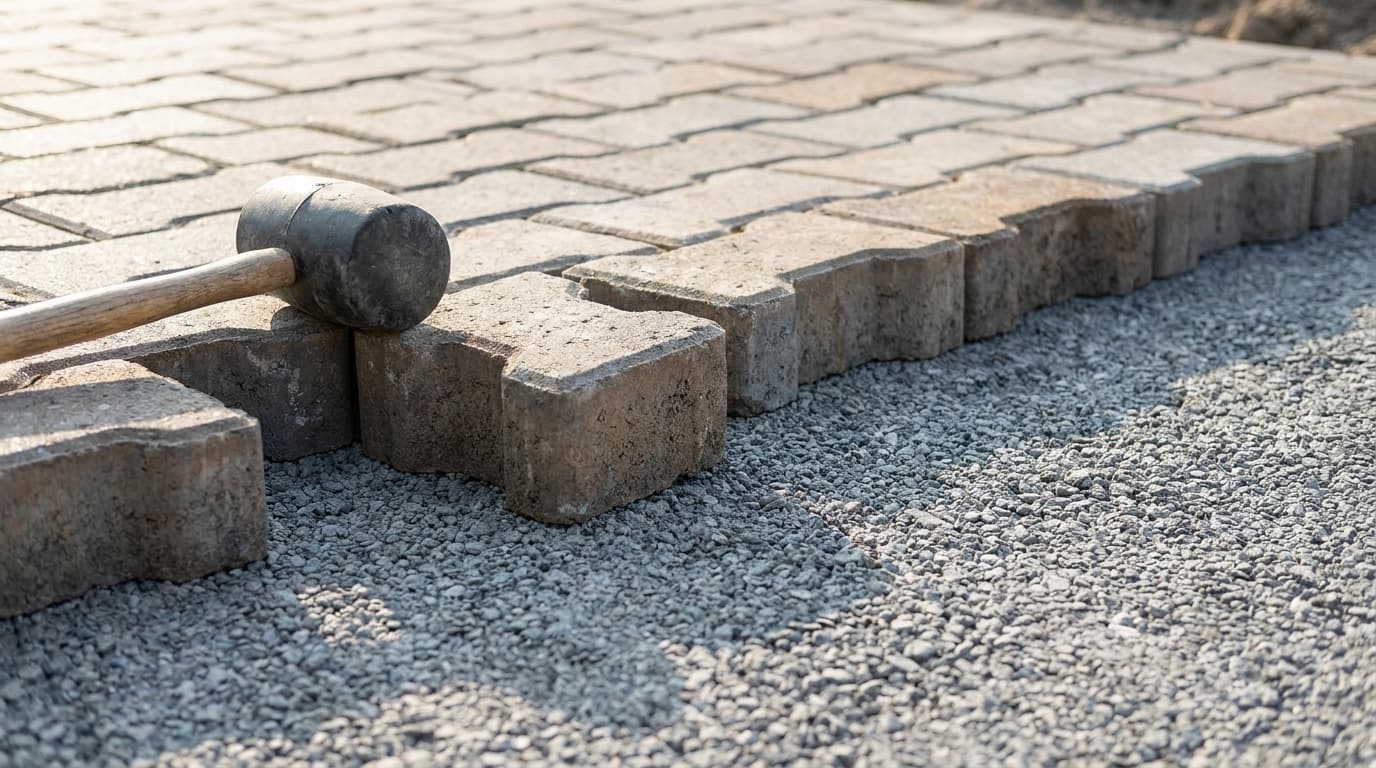
1 inch of coarse bedding sand (ASTM C33 concrete sand) for dense-graded base systems, or 1 inch of ASTM No. 8 or No. 9 chip for open-graded systems. Screeded flat over screed rails, never compacted before pavers are set, and never used to fix a base that was graded poorly.
Why 1 inch matters: bedding compresses under the plate compactor after pavers are set. 1 inch compresses down to roughly 3/4 inch predictably and uniformly. 3 inches compresses unpredictably, and every place the depth varies becomes a future dip. We have torn out patios with 4 inches of sand under them. Every one of them was a wave field.
Never use mason sand or play sand for bedding. Too fine, holds water, migrates.
How the Spec Changes by Project Type
Patios and walkways: 6 to 8 inches compacted base. Foot traffic only. The main enemy is water, not load.
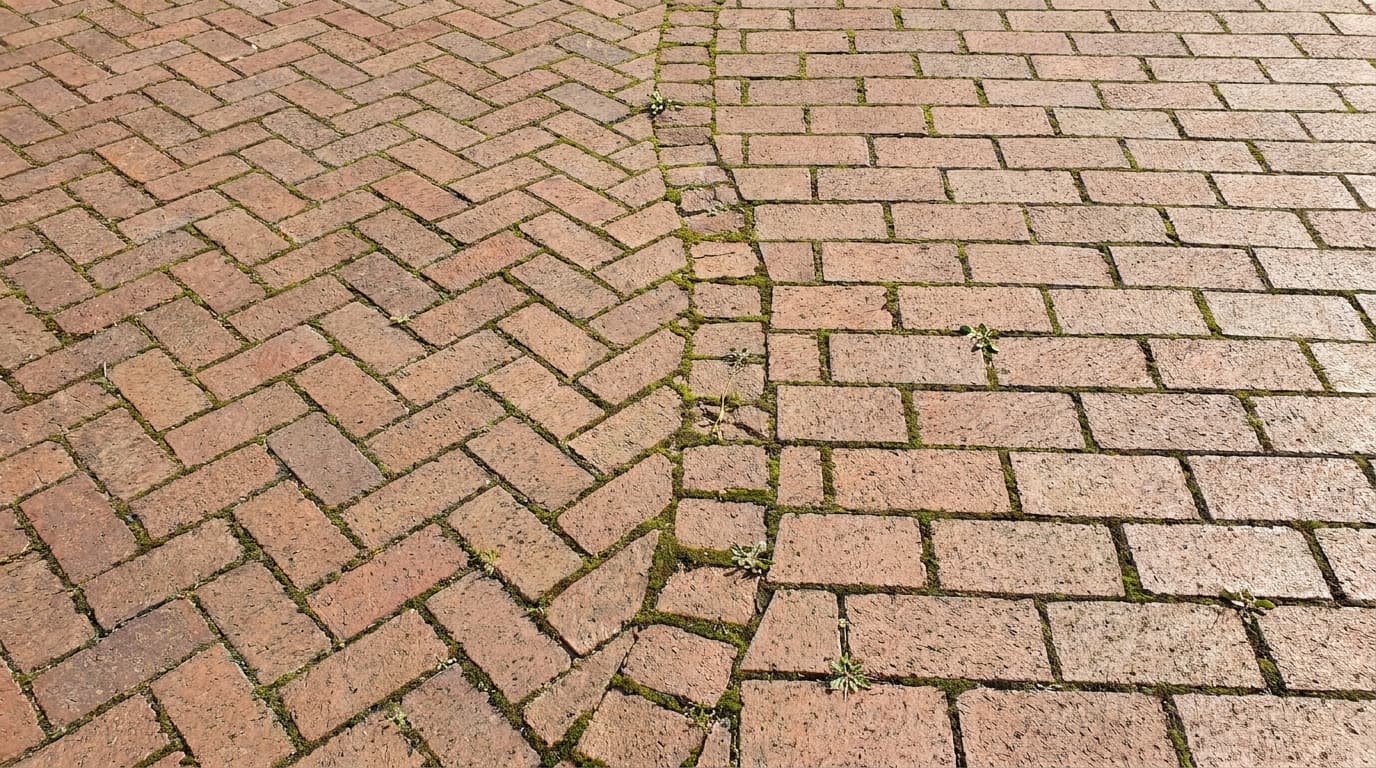
Driveways: 8 to 12 inches compacted base, and we lean toward 10 minimum on Charlotte clay. Thicker 3 1/8-inch pavers instead of 2 3/8. Herringbone laying pattern at 45 or 90 degrees, which interlocks far better under turning vehicle loads than running bond. Extra attention at the apron and any spot where a delivery truck will turn.
Pool decks: 6 to 8 inches base, but the real issue is that the soil around a pool shell was excavated and backfilled. That backfill is often poorly compacted. We over-excavate and rebuild the first 3 to 4 feet around the shell rather than trusting it. Slope must run away from the pool coping, and open-graded base is often the better call for drainage.
Steep or sloped lots (common in Belmont, Mount Holly, and older Huntersville neighborhoods): terraced base construction, sometimes with a low retaining element, and drainage interception uphill of the paved area.
Red Flags: What a Shortcut Base Looks Like on a Bid
Scan your estimates for these. Any one of them is worth a direct question.
- "4-inch base" quoted for a driveway
- Excavation depth and base depth stated as the same number
- No mention of geotextile fabric anywhere
- Base material described only as "gravel" with no type named
- No mention of compaction, lifts, or equipment
- "2 to 3 inches of sand" as a bedding layer
- Edge restraint not listed as a separate line item
- A start date within 48 hours of a heavy rain, on clay
- A price per square foot dramatically below every other bid — the difference is almost always underground
Good paver base preparation is not glamorous and it does not photograph well. It is also the entire reason one patio in Concord looks new at year fifteen and an identical-looking one down the street needed relaying at year four.
Frequently Asked Questions
On our red clay, 6 to 8 inches compacted for patios and walkways, 8 to 12 inches for driveways, plus 1 inch of bedding. That is deeper than generic national guidance because Charlotte clay drains poorly and moves seasonally. Total excavation typically runs 10 to 16 inches depending on the application.
Crusher run gives higher load capacity and is our default for driveways and most patios. Clean open-graded stone drains freely and suits permeable systems and damp shaded sites, but it needs a designed outlet for the water. Both work well when built correctly. Problems come from mixing the two approaches in one system.
Yes, with limits. We install through Charlotte winters regularly. We will not place base on frozen subgrade, and we will not compact saturated clay. Cold slows polymeric sand curing, so we watch temperature windows on the final step. Winter installs often move faster than spring because the ground is drier.
On a typical 500 square foot patio, excavation and base usually take 2 to 3 working days of the total project. Driveways run longer. If a crew finishes excavation and base in one afternoon on Charlotte clay, something was skipped.
Planning something similar? See how we approach paver patio installation in Charlotte and the surrounding metro, or find your town in our service area.
Get a Free Estimate
We are happy to walk your yard, probe the existing base if there is one, and show you the depths we would build to.
Get a Free Estimate