.jpg)
The segmental retaining wall vs concrete decision comes down to three things: how the wall handles water, how it moves with the soil, and what happens when something goes wrong. Charlotte's red clay swells when wet and shrinks when dry, which punishes rigid structures and rewards flexible ones. Below is an honest head-to-head across four materials we install and repair across Mecklenburg and Union counties.
The Four Options in Plain Terms
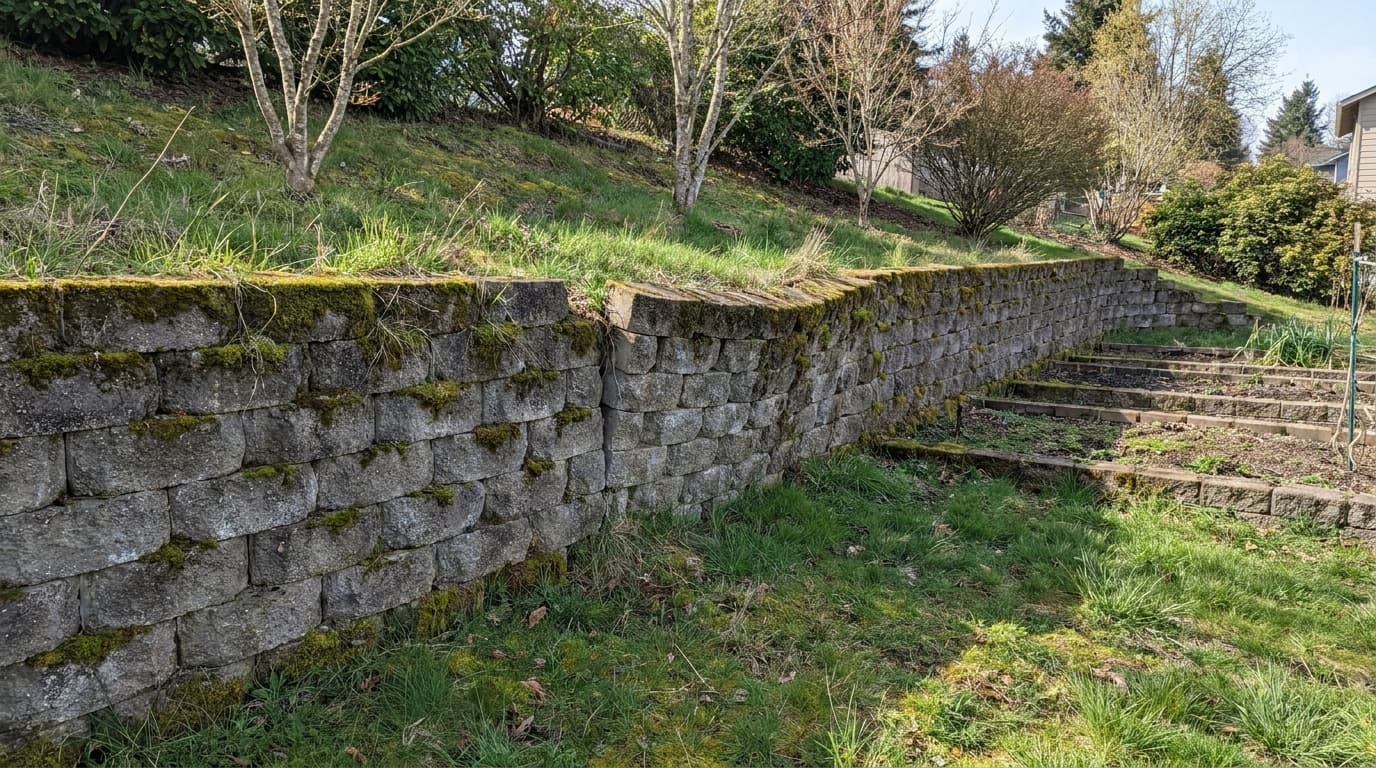
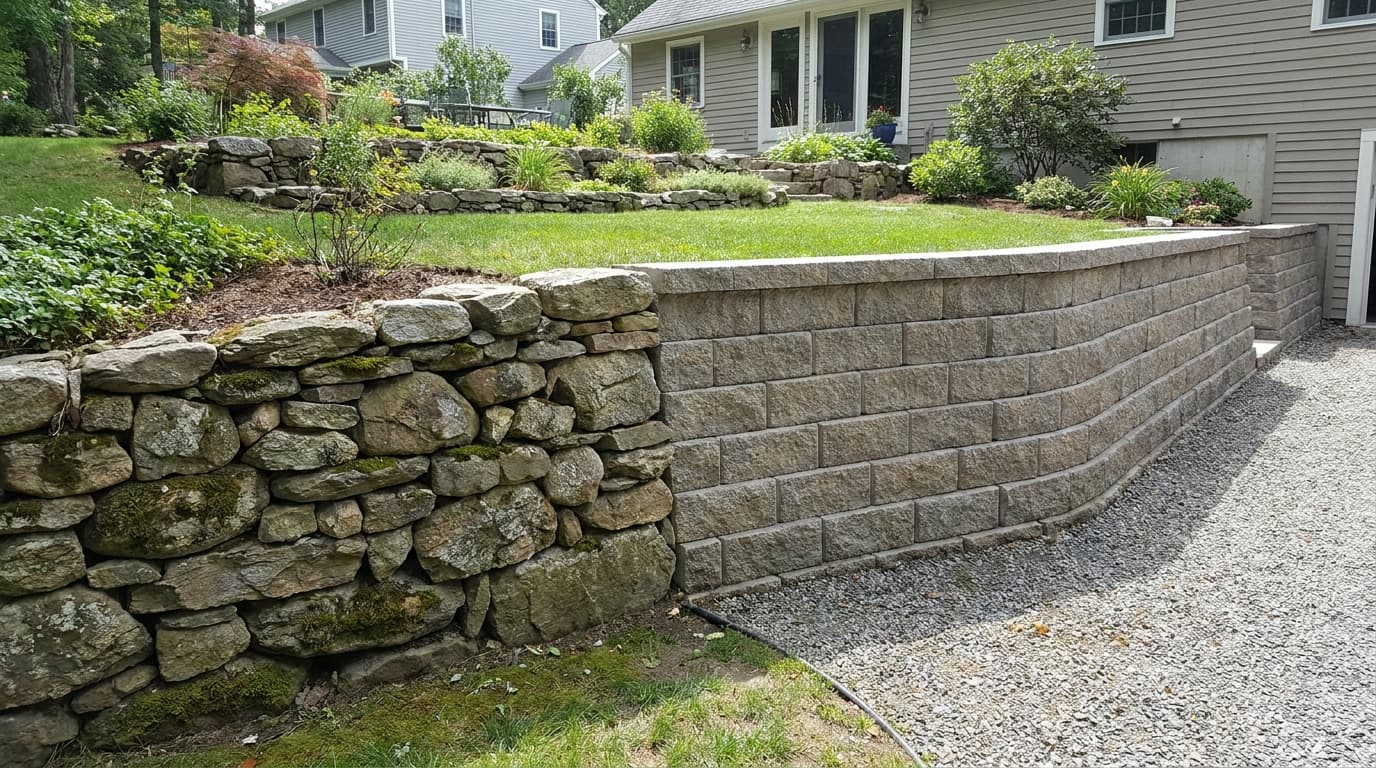
Segmental retaining wall block (SRW). Dry-stacked manufactured concrete units, no mortar. Each course locks into the one below with a lip or pin. Reinforced with geogrid layers when height demands it.
Poured concrete (cast-in-place). Formed and poured on site, usually with a reinforced footing and rebar. One monolithic structure.
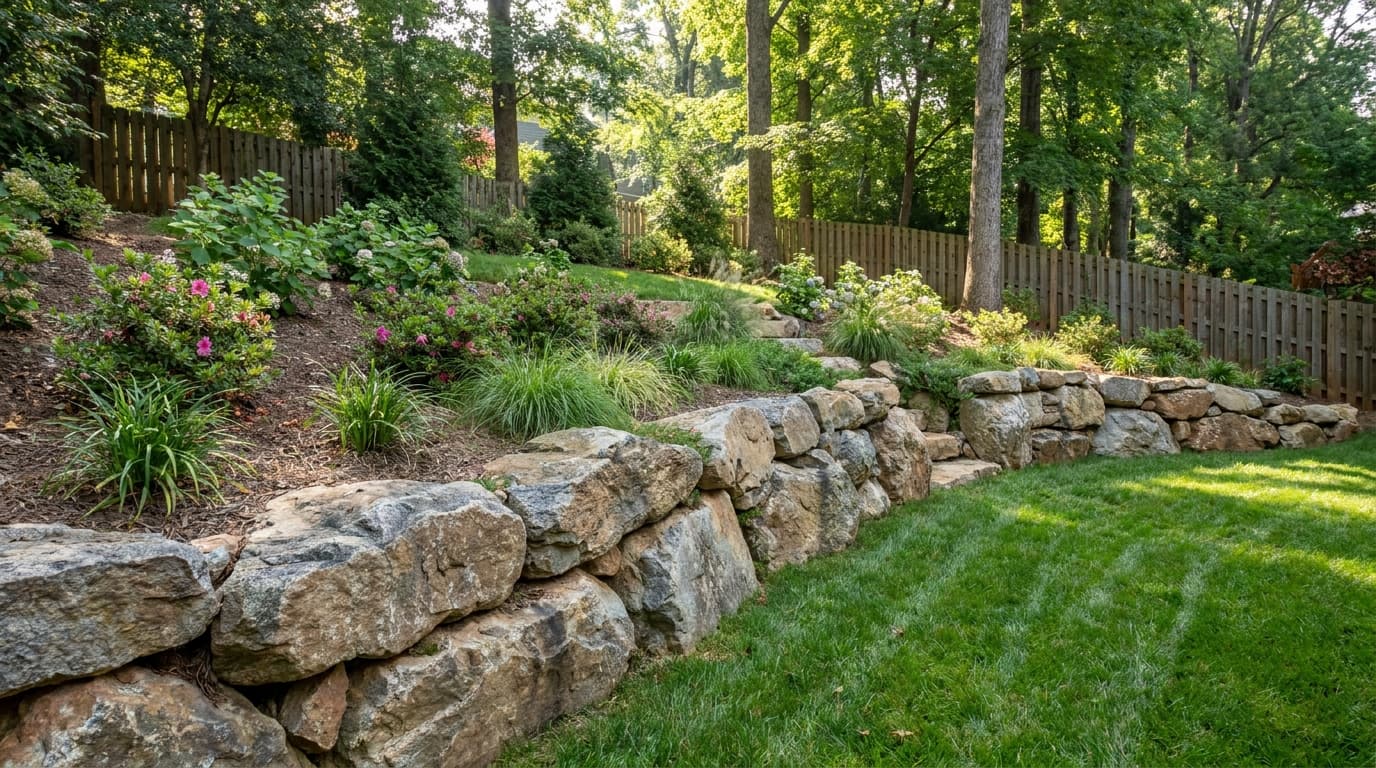
Boulder walls. Stacked natural stone, typically 200 to 2,000 pounds per piece, set with an excavator. Gravity-based.
Treated timber. Pressure-treated 6x6 landscape ties with deadman anchors running back into the slope. Common in 1980s and 1990s Charlotte subdivisions.
Cost Per Face Foot, Installed
Face footage is length times exposed height. Charlotte-area installed ranges:
- SRW block, under 4 ft: $35 to $55 per face foot
- SRW block, 4 to 6 ft with geogrid: $55 to $85 per face foot
- Poured concrete, under 4 ft: $60 to $95 per face foot
- Poured concrete, over 4 ft engineered: $90 to $160 per face foot
- Boulder wall: $45 to $90 per face foot
- Treated timber: $25 to $45 per face foot
Poured concrete carries fixed costs that hurt small jobs. Formwork, a concrete truck minimum, and rebar setup do not scale down. A 120 face foot poured wall often prices close to a 200 face foot block wall.
Lifespan: What Actually Fails First
- SRW block: 40 to 75 years when drainage is built correctly. Units are high-compressive-strength concrete. Failures are almost always drainage or base failures, not block failures.
- Poured concrete: 50 to 80 years if reinforcement stays uncorroded and water never sits behind it. Once rebar rusts, spalling accelerates fast.
- Boulder walls: effectively indefinite for the stone. Settlement and rotation of individual boulders is the failure mode, usually at 15 to 30 years on clay.
- Treated timber: 15 to 25 years in the Carolina climate. Ground contact plus humidity plus insects. The deadmen rot before the face does, which is why old timber walls lean forward while looking solid from the front.
Drainage Behavior: The Real Separator
This is where segmental retaining wall vs concrete stops being a style question.
An SRW wall is porous by design. Open joints between blocks let water weep through the face. Combined with 12 inches of No. 57 clean stone behind the units and a perforated drain pipe at the base, hydrostatic pressure has multiple escape routes. Even if the pipe partially clogs, the face still breathes.
Poured concrete is a dam. Water cannot pass through it. Every drop must reach the weep holes or the drain line. If those clog, pressure builds against a rigid surface with nowhere to go. A saturated clay backfill can push with substantial force, and concrete does not flex before it cracks.
Boulder walls drain well through the gaps, but the gaps also let fines migrate out unless geotextile separates soil from stone.
Timber walls drain adequately when new. As the wood swells and the deadmen rot, the assembly loses both drainage and restraint at the same time.
Freeze-Thaw in North Carolina
Charlotte gets roughly 60 to 85 freeze-thaw cycles a year, concentrated December through February. We do not get deep sustained freeze like Minnesota. We get repeated shallow freezing of wet soil, which is arguably harder on rigid structures.
Segmental block tolerates this well. Individual units can shift a fraction of an inch and reseat without cracking the structure. That flexibility is the whole design philosophy.
Poured concrete concentrates the same movement into cracks. We see hairline vertical cracks at 8 to 15 foot intervals in older poured walls around Myers Park, usually at points where no control joint was placed.
Boulder walls shrug off freeze-thaw. Timber absorbs water, freezes, and delaminates at the fastener points.
How Each Behaves on Charlotte Red Clay
Piedmont red clay is the local variable everyone underestimates. It holds water, drains slowly, and changes volume seasonally.
SRW block works with the clay. The flexible face accommodates seasonal soil movement. The mandatory clean-stone zone gives water somewhere to go instead of into the clay behind the wall.
Poured concrete needs an excellent footing below frost depth and excellent drainage, or clay pressure works on it year after year. We have taken out poured walls in Concord where the footing had rotated 2 to 3 degrees because the clay beneath it stayed saturated.
Boulder walls need a wide base on clay, generally at least 60 percent of wall height in base depth, or the bottom course slowly rotates outward.
Timber and clay are a bad match long-term. Constant moisture at the wood-soil interface accelerates rot.
Repairability
- SRW block: the best of the four. Individual courses can be taken down and reset. A 30-foot section rebuild typically runs $2,200 to $5,500. Matching block is usually available if the line is still made.
- Poured concrete: difficult. Cracks can be epoxy-injected for $400 to $1,200, but structural rotation means demolition. Removal alone runs $25 to $50 per face foot.
- Boulder walls: individual boulders can be reset with a machine, $800 to $2,500 for a localized fix, assuming access.
- Timber: rarely worth repairing. Replacement is the answer.
Build Time and Curing
- SRW block: usable immediately. A 150 face foot wall takes 4 to 7 working days including excavation and drainage.
- Poured concrete: forming, pouring, and stripping runs 7 to 14 days, then concrete needs roughly 28 days to reach design strength before full backfill loading. Total timeline is often 4 to 6 weeks.
- Boulder: fastest, 2 to 4 days for a comparable wall with machine access.
- Timber: 3 to 5 days, and we do not build them anymore.
Appearance
Block gives you the widest range: tumbled faces, split faces, large-format units, and colors that read as stone from 10 feet away. It is manufactured, and up close it looks manufactured.
Poured concrete is smooth and modern. It suits contemporary homes in Dilworth and SouthPark, especially with board-form texture or a stone veneer applied over it.
Boulders read rustic and natural. On wooded lots in Weddington and Davidson they belong. Next to a crisp travertine pool deck they can look out of place.
Pick This If...
- Pick SRW block if your wall is between 2 and 8 feet, sits on clay, and you want proven drainage performance with repairable joints. This covers roughly 80 percent of Charlotte residential walls.
- Pick poured concrete if you need a thin footprint against a property line, want a modern architectural face, or you are tying into an existing foundation or basement wall.
- Pick boulders if the lot is rustic, access is good, and the wall is under about 4 feet with room for a deep base.
- Pick timber only if you are patching an existing timber wall to buy a season or two. Do not build a new one.
A Pineville Example
A homeowner off Highway 51 in Pineville had a 1998 poured concrete wall retaining the driveway edge, about 5 feet tall and 48 feet long. Vertical cracks ran from the top down, and the whole wall leaned about 2 inches at the north end. The weep holes had silted shut, probably years earlier.
Repair was not realistic. We demolished it and rebuilt with geogrid-reinforced SRW block, full 12-inch No. 57 stone column, geotextile, and a 4-inch perforated pipe daylighted to the ditch. Total came to $21,400, of which $3,900 was demolition and disposal of the old concrete. The rebuild cost less than a rebuild in poured concrete would have.
Frequently Asked Questions
Per unit of material, yes. As a system, not necessarily. A geogrid-reinforced block wall uses the retained soil itself as part of the structure, which distributes load across a wide mass. Poured concrete resists load as a single rigid element. On clay that moves seasonally, the flexible system often outperforms the rigid one.
Yes, but it changes the design. Veneer closes off the porous face that lets an SRW wall weep, so drainage behind the wall has to be flawless. Cost runs $110 to $180 per face foot total. Many homeowners get a similar look for less by choosing a premium-face block.
The face boards look fine because they are visible and get replaced. The deadman anchors buried in the hillside rot invisibly. When those fail, the wall relies only on friction and the weight of the ties. Many walls in older Charlotte subdivisions are in that borderline state right now.
Segmental block, in most Charlotte scenarios. It has a moderate install cost, a long service life, and the lowest repair cost when something needs attention. Timber is cheapest on day one and most expensive by year twenty, because you pay for the wall twice.
Planning something similar? See how we approach paver patio installation in Charlotte and the surrounding metro, or find your town in our service area.
Get a Free Estimate
Tell us your wall height, length, and what sits above it, and we will give you a straight comparison of materials with real numbers for your lot.
Get a Free Estimate