Terracing a sloped backyard in Charlotte usually costs between $8,000 and $45,000, and the single biggest cost driver is how much dirt has to move. Most lots in Mint Hill, Waxhaw, and the neighborhoods off Providence Road drop 3 to 12 feet across the rear yard. That drop is why the grass never fills in and the swing set sits crooked. Terracing fixes it by converting slope into usable flat area.
One Tall Wall or Several Terraces?
The instinct is to build one wall at the bottom of the hill and backfill behind it. Sometimes that is right. More often it costs more than people expect, because wall cost climbs faster than wall height.
A 6-foot wall is not twice the cost of a 3-foot wall. It needs a deeper base trench, more geogrid layers running back into the hill, more excavation behind the face, and almost always an engineer's stamp. Cost per square foot of exposed face climbs as height climbs.
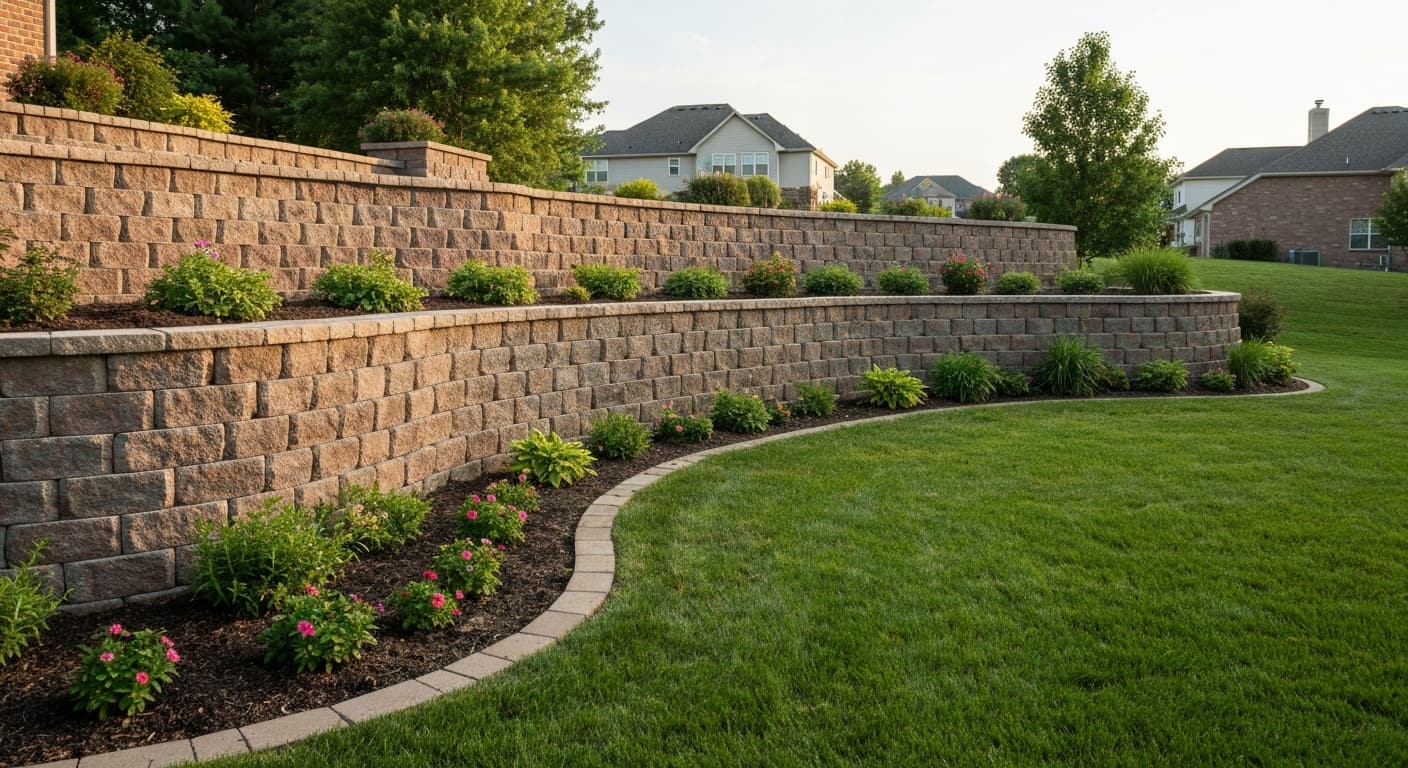
Multiple lower terraces spread the load. Two 3-foot walls often price out below one 6-foot wall, and they give you two planting levels instead of one blank face. The tradeoff is footprint. Terraces eat horizontal space, so a shallow yard may not have room for them.
The Spacing Rule That Decides Everything
Here is the rule that separates a real terrace design from two walls stacked in a row: terraces should sit at least 2 times the height of the lower wall apart, measured horizontally from the back of the lower wall to the face of the upper one. Below that spacing, the upper wall's load pushes into the lower wall's reinforced zone, and the pair behaves like one tall wall for stability purposes.
That matters because it changes the engineering. Two 4-foot walls spaced 10 feet apart are two independent 4-foot walls. The same two walls spaced 4 feet apart act like an 8-foot structure, and an 8-foot structure needs design, geogrid, and permits.
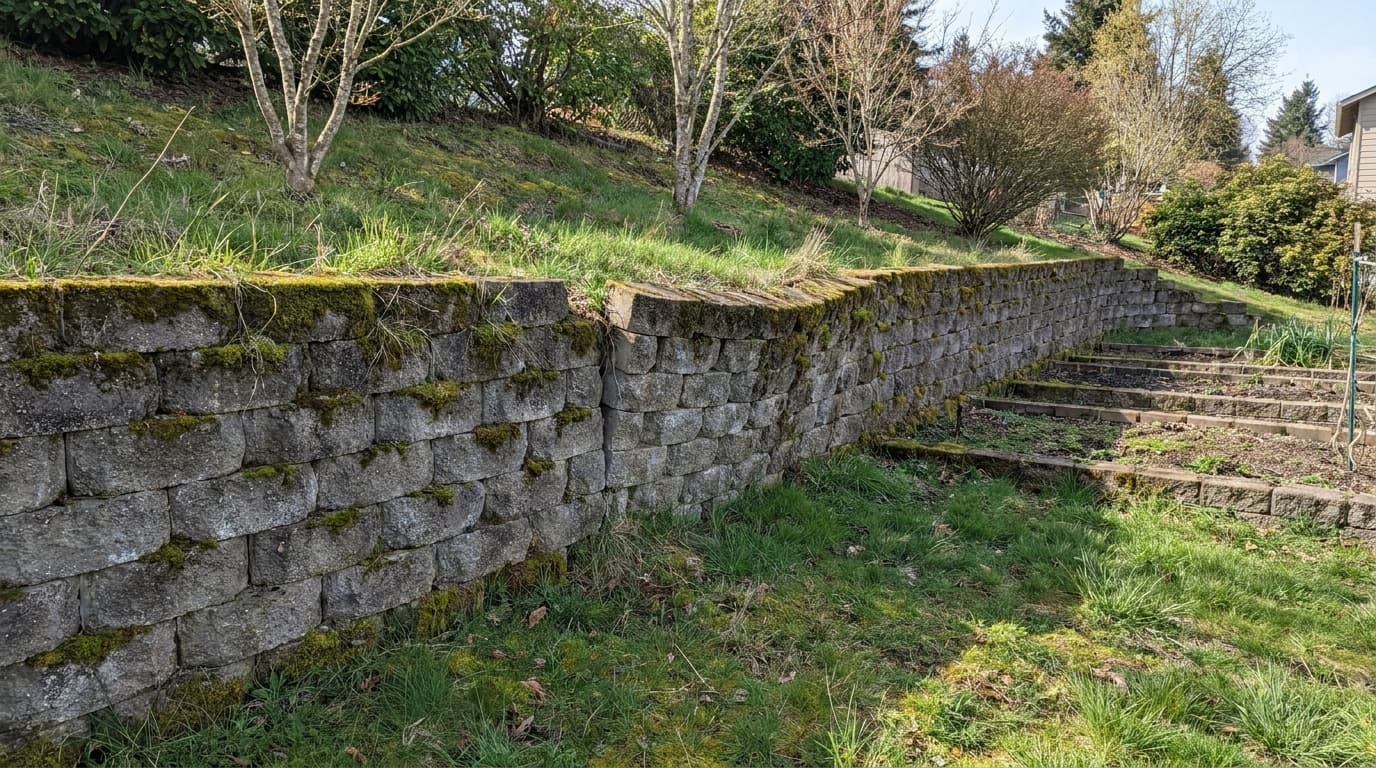
We see this mistake on resale inspections around Ballantyne and Indian Trail. Someone built a stair-step of three short walls with 3-foot benches between them to save money, and five years later the middle wall is leaning out. The math never worked.
How Much Flat Yard You Actually Gain
Homeowners want a number for usable space, so here is the honest version. On a yard falling 1 foot for every 6 feet of run, a 4-foot wall gives you roughly 24 feet of level depth behind it, minus what you lose to the wall's own reinforced backfill zone.
Rough gains we quote:
- 3-foot wall on a moderate slope: about 15 to 20 feet of level depth
- 4-foot wall: about 20 to 28 feet of level depth
- 6-foot wall: about 30 to 40 feet, but with engineering and permit costs attached
- Two 3-foot terraces: two usable benches, often 12 to 18 feet deep each
A 20 by 40 foot flat bench is enough for a patio, a fire pit seating circle, and a walking path. That is the target for most families.
Installed Cost Per Square Face Foot
Face footage is length times exposed height. A wall 40 feet long and 4 feet tall is 160 face feet. Charlotte-area installed ranges we work from:
- Standard segmental block, under 4 feet, no geogrid: $35 to $55 per face foot
- Segmental block, 4 to 6 feet, geogrid reinforced: $55 to $85 per face foot
- Large-unit or premium-face block: $65 to $110 per face foot
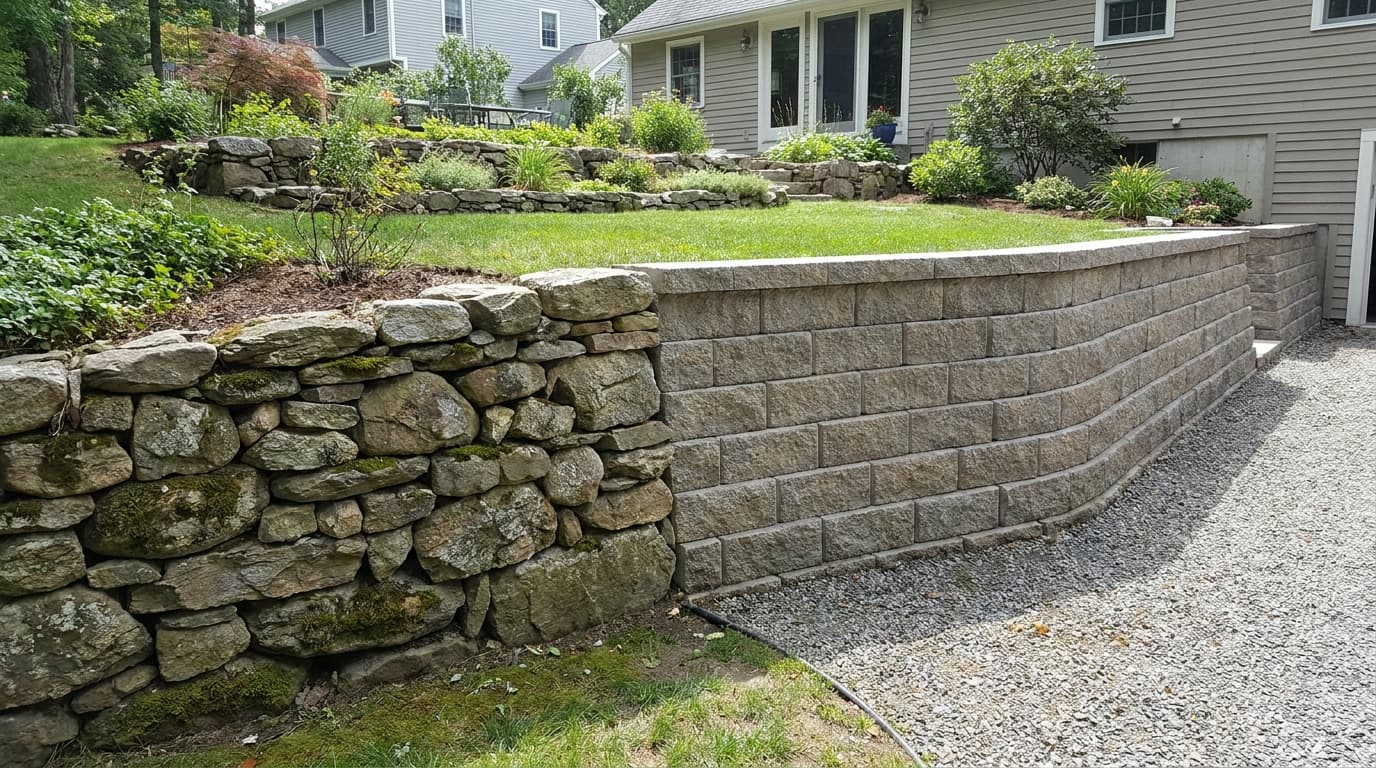
- Natural stone veneer over block core: $110 to $180 per face foot
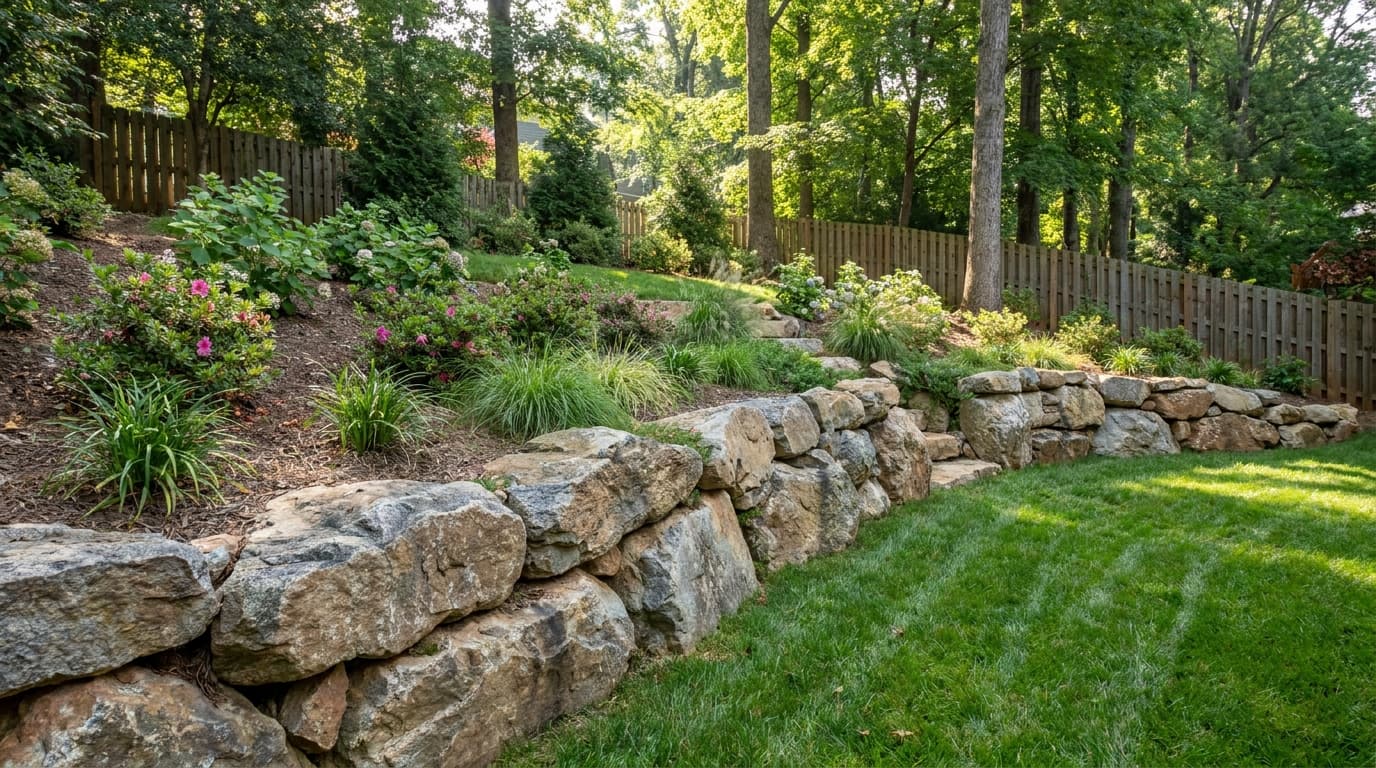
- Boulder wall, machine-set: $45 to $90 per face foot depending on stone haul distance
Those numbers include base excavation, compacted aggregate leveling pad, No. 57 drainage stone, geotextile, perforated drain pipe, and capstones with adhesive. They do not include haul-off, access issues, or steps.
Excavation and Haul-Off: The Line Item People Forget
Cutting into a hillside produces dirt. Charlotte red clay weighs roughly 2,700 to 3,000 pounds per cubic yard when damp, so a small excavation gets heavy quickly.
Costs we see:
- Machine excavation and grading: $18 to $35 per cubic yard on accessible lots
- Haul-off and disposal: $28 to $55 per cubic yard including trucking
- Hand-dig surcharge for gated or narrow-access yards: 30 to 60 percent more labor
- Access matting or fence removal and reset: $400 to $1,500
On tight lots in Dilworth and Plaza Midwood, access drives the whole budget. A yard reachable only through a 36-inch gate can double the labor line compared to the same job in Huntersville with an open side yard.
Keeping spoil on site helps. If we can shape excess clay into a berm or use it as fill behind an upper terrace, we cut haul-off substantially.
Steps Between Levels
Terraces need connection. Skipping the steps is how a beautiful two-level yard becomes a place nobody walks.
Typical Charlotte pricing:
- Block-and-cap steps, 4 feet wide: $450 to $750 per step
- Solid stone slab treads (36 to 48 inches): $550 to $950 per step
- Paver stair landing, 5 by 5 feet: $900 to $1,600
- Low-voltage step lighting: $110 to $190 per fixture installed
A 4-foot grade change usually means 6 or 7 risers at 7 inches each. Budget $3,000 to $5,500 for a comfortable, code-friendly run with a landing.
An Itemized Real Project: Matthews, Two Terraces
A family off Sardis Road in Matthews had a rear yard dropping about 7 feet over 50 feet. The kids' play area sat on a side hill. We built two terraces instead of one tall wall.
| Line item | Cost |
|---|---|
| Mobilization, layout, utility locates | $850 |
| Excavation, 46 cubic yards | $1,380 |
| Haul-off, 31 cubic yards clay | $1,240 |
| Lower wall: 44 ft long x 3.5 ft, 154 face ft @ $48 | $7,392 |
| Upper wall: 38 ft long x 3 ft, 114 face ft @ $46 | $5,244 |
| No. 57 drainage stone and geotextile, both walls | $1,610 |
| Perforated drain pipe, two daylight outlets | $780 |
| Stone steps, 6 risers with landing | $4,100 |
| Topsoil and sod, 1,900 sq ft bench | $2,470 |
| Cleanup and final grade | $620 |
| Total | $25,686 |
Terraces sat 9 feet apart, comfortably past the 2x spacing threshold. Neither wall needed an engineer's stamp. Build time was eleven working days, with two lost to August thunderstorms.
What Pushes a Terracing Budget Up
- Walls over 4 feet of exposed height, which trigger engineering and permits
- A driveway, pool, or structure sitting above the wall (surcharge load)
- Springs or seeps in the hillside, common on north-facing lots near Mountain Island Lake
- Poor access requiring wheelbarrow work
- Premium block faces or natural stone veneer
Frequently Asked Questions
Most two-terrace projects run 8 to 15 working days. Rain adds days, because we cannot compact wet Charlotte clay properly. A single wall under 4 feet with easy access can finish in 4 to 6 days. Engineered walls add 2 to 4 weeks upfront for design, permitting, and inspection scheduling.
Yes, and it is often smart. We design the full grade plan first, then build the lower terrace this season and the upper one next year. The key is planning drainage for the finished condition from day one, so the phase-one drain lines already handle the eventual upper terrace runoff.
Short walls generally do not, but thresholds and surcharge rules vary, and enforcement is local. Confirm with Mecklenburg County before you build. If any wall carries a driveway, pool, or slope above it, assume you need engineering regardless of height.
Sometimes. Boulder walls run $45 to $90 per face foot and go up quickly with a machine. They need more footprint, since the base course sits deeper into the hill, and they are harder to build with tight, clean lines. On rustic lots in Weddington they look right. Beside a formal patio, block usually wins.
Planning something similar? See how we approach paver patio installation in Charlotte and the surrounding metro, or find your town in our service area.
Get a Free Estimate
Send us your yard's rough dimensions and a few photos of the slope, and we will walk you through terrace layouts and honest numbers before anyone signs anything.
Get a Free Estimate